Showing posts with label reading. Show all posts

Saturday, September 05, 2009

Resolute

Resolute: The Epic Search for the Northwest Passage and John Franklin, and the Discovery of the Queen's Ghost Ship Resolute: The Epic Search for the Northwest Passage and John Franklin, and the Discovery of the Queen's Ghost Ship by Martin W. Sandler


My rating: 3 of 5 stars

I would recommend this book. It may seem like the last subject you'd want to read about: a bunch of 19th century Britons trying to find a way to the Pacific Ocean over the top of North America.

I'll be honest, if you had asked me if I knew what the North West Passage was before I read this book, I would have told you that is what Lewis and Clark were looking for.

OK, so some random thoughts:

• though the title is "Resolute" the book is far broader than about a boat that was lost and then found while looking for someone else that was lost.

• the whole Arctic expedition thing was about two things: Finding the Northwest Passage, and/or finding the North Pole. The one who found either first would bring both personal and national glory.

• the Royal navy was too proud to think about seeking counsel from those who might actually have experience in the Arctic. Namely the native Inuit people, who knew how to survive the year-round cold, and the whalers who knew how to navigate the ice flows and northern climates.

• The people who explored and were lost or died or even returned unsuccessful in their quest were seen as heroes. This whole Arctic thing was a pretty big deal in the mid 1800's and captivated public attention, even though these explorers would leave and vanish from public consciousness for years at a time.

I would recommend this book because this vast story is well-told. There are a lot of characters spanning the approximately 80 years of attempts to conquer the Arctic, but Martin W. Sandler organizes his book well with extended end notes (that stay out of the way of the drama of the story) and appendices that are quite interesting.

View all my reviews >>

Saturday, July 18, 2009

Flyboys: A True Story of Courage

Flyboys: A True Story of Courage Flyboys: A True Story of Courage by James Bradley

My rating: 4 of 5 stars
In high school there are certain things that you learn about World War II. Years later, there are much fewer things that you remember. There was Hitler, D-Day, FDR, the attack on Pearl Harbor by the Japanese, the battleship and carrier wars fought in the Pacific over little tiny islands in the middle of nowhere, and finally the first use of the atomic bomb by the US on two Japanese cities.


There were plenty of new perspectives to be gained on the war in the Pacific through James Bradley's book Flyboys: A True Story of Courage. Though the book focused on 8 specific pilots and gunners, as well as their background and families, their individual stories were presented in context--not just of the war, but of Japanese history, culture and mindset.


There were several theses Bradley skillfully presented in this book. Here are some bullet-pointed highlights:


• The Japanese and American cultures could not have been more opposite one another. In everything from the way they ate their meals, to the way they saw their place in the world, these were two very different "worlds" at war, neither able to truly empathize or understand one another.


• Previous to World War II, the primary dimensions for battle were land and sea. FDR pushed hard for the monies to invest in this new 3rd dimension, the air war. Indeed, it proved pivotal in both the Pacific and in Europe.


• Japan "learned" imperialism by observing the west. They believed they were doing the best thing for China by invading it in order to "culture" it with it's own brand of civilization. Japan as a country felt snubbed at the end of World War I when they were awarded very little territory and concluded that this was as much a racial decision against them as anything. They had been exercising the same ethnic cleansing they observed in the US as the anglo-saxon race obliterated the native tribes in the name of civility and religious conversion.


• Though there existed much honor in Japanese warriors of previous generations in the 18th century, the generation that fought World War II perverted the standards and practices handed down to them, and with a mixture of mythicism and power-hungry leaders, led the nation to believe that even in the face of hopelessness, they were as valuable in death (in war) as they were in life. Surrender was the ultimate act of cowardice and shame, even among the civilians, who, in the impending land war with the US army, would fight to the end with sharpened bamboo sticks.


• While condemning the bombing of civilians of England by Germany, the US apparently saw nothing inconsistent with bombing city after city in Japan indiscriminately. There was no urban planning in Japan. Wooden houses were built right next to large factories in Japanese cities. The Napalm burned both easily, and as a result, many Japanese civilians were killed or made homeless.


• The dropping of the atomic bombs on Hiroshima and Nagasaki were not out-of-the-blue acts of desperation or experimentation that led to the surrender of Japan. The use of these weapons were actually the next logical step in the systematic bombing of many Japanese cities by B29s in an effort to delay a ground war and were used in the hopes of bringing a swift surrender. We are awed by the destruction of a single bomb, but the damage done was commensurate with what was already being done using many planes and many pipes of Napalm.


The temptation when reading a book that deals with such difficult subject matter is to confuse the quality of the book with its content. Some passages in this book were difficult to read. Anecdotes and interviews of Japanese soldiers that fought in many fronts: Iwo Jima, ChiChi Jima, New Guinea, the Philippines, and China were gruesome and disturbing. Stories of torture and cannibalism abound. Bradley uses these stories not gratuitously, but to reinforce the thesis previously mentioned about the Japanese warrior mindset at the time and also to proudly display the bravery of the American and Japanese soldiers in the face of certain death.


Yes, it is difficult to recommend a book with such material-like what a Stephen King book is like, except with real events-but the story is well-told, the research is thorough, and the book is well-cited. Reading this book brought the Pacific theater to life and gave me a renewed respect for the generation that fought in World War II.


View all my reviews >>

Monday, March 30, 2009

Worship Matters: Book Review

Worship Matters: Leading Others to Encounter the Greatness of God Worship Matters: Leading Others to Encounter the Greatness of God by Bob Kauflin

My review


rating: 4 of 5 stars
If you follow Bob Kauflin's blog, you know that his routine of answering people's questions about church music ministry is done very deliberately. He doesn't rant. He encourages right relationships first. He emphasizes biblical principles, and in the end he'll get around to answering the question, an answer that usually seems more obvious once he cuts to the heart of the issue, and what is really important. It is no surprise then to see his book written in the same style, and with the same patience we've come to expect from him. Worship Matters is more than just another book about worship, and it is more than a little commentary and list of suggestions on how to "do music" better.
Summary
Bob Kauflin's book Worship Matters is a very useful guide for church music volunteers to music directors to worship leaders, to senior pastors. The book's primary focus, however is on worship leaders. He takes his time patiently addressing each topic, even sometimes repeating himself, but not to anyone's detriment. The book serves as a healthy reminder to those who would lead worship-musical or non musical, as to what is important and what should be remembered, and what can safely be discarded.

The book is divided into four main sections. The first deals with the worship leaders in five short chapters. What is important, what should be important? what are the things the leader should love? what are things the leaders believe? what are the things leaders practice? what are the things leaders model?

It is a great centering area of the book for worship leaders to ruminate on even before proceeding further along in the book.

Part two of the book deals specifically with what a worship leader does. Here he presents his definition:
A faithful worship leader
magnifies the greatness of God in Jesus Christ
through the power of the Holy Spirit
by skillfully combining God's Word with music,
thereby motivating the gathered church
to proclaim the gospel,
to cherish God's presence,
and to live for God's glory.

He spends the next several chapters exegeting his own statement, exploring and giving insight phrase by phrase. Here Kauflin gives a nice mix of scriptural, philosophical, and practical teachings and suggestions for understanding the worship leader's role.

The third part to his book explores what he terms "Healthy Tensions." Using the following principles, 1. Do what God clearly commands. 2. Don't do what God clearly forbids. 3. Use scriptural wisdom for everything else.

Even though he spends time expanding on these tensions, I find that the most insight is gained by pondering the existence and identification of the tensions alone. Not meant to be a comprehensive list, Kauflin lists the following:

  • Transcendent and Immanent
  • Head and Heart
  • Internal and External
  • Vertical and Horizontal
  • Planned and Spontaneous
  • Rooted and Relevant
  • Skilled and Authentic
  • For the Church and Unbelievers
  • Event and Everyday

The fourth part deals with Right Relationships: Church, Team, and Pastor. It is always good to be reminded of healthy relationships, and their importance, particularly in church leadership. This section of the book was probably the most meaningful to me, as with great humility Kauflin framed healthy church leadership relationships in light of submission to the pastor, seeking to give encouragement, seeking biblical steps in resolving conflict, nipping personal pride, and seeking evaluation and reproof. Proverbs 12:1 "Whoever loves discipline loves knowledge, but he who hates reproof is stupid."

The end notes to this book contain a robust annotated bibliography, short on music sources and heavy on theology. This is no surprise as his writing is rich with scriptural references and one of his fundamental perspectives is that the worship leader, just as all followers of Christ, should first seek to be a theologian.


Some favorite quotes:


A worship leader who barely knows the Bible can't be a faithful worship leader.

We're good theologians if what we say and think about God lines up with what Scripture says and affirms. We're bad theologians if our view of God is vague, unbiblical, distorted, or based on our own opinions.

Misconception: We know God better through music than through Words.

When we're dodgy about our theology, we're really saying we want our own Jesus.

[God] never gets tired of hearing believers' almost-in-tune, somewhat together, faith-filled offerings of worship.

If our doctrine is accurate but our hearts are cold toward God himself, our corporate worship will be true but lifeless. Or if we express fervent love for God but present vague, inaccurate, or incomplete ideas of him to those we're leading, our worship will be emotional but misleading-and possibly idolatrous. Neither option brings God glory.

If you have a role in leading worship in church or parachurch, this book will be well worth your time. Whether you're the primary worship leader, a "chief musician," a volunteer, or a senior pastor, I highly recommend this book and it's valuable insights to you.


View all my reviews.

Tuesday, December 30, 2008

Beyond Opinion

Beyond Opinion: Living the Faith We Defend Beyond Opinion: Living the Faith We Defend by Ravi Zacharias


My thoughts on this book


rating: 3 of 5 stars
This book was not written by Ravi Zacharias. I just wanted to get that out of the way. I noticed right away (but only after I got the book in my hands) that each chapter is written by a contributor, and is edited by Zacharias, though he does contribute to a few of the chapters.


Though the book is organized in a logical manner, it would work fine to take the segment you are interested in and read just that portion. One of the strengths of a book like this is that if you tire of a particular author, you only need to wait until that particular essay is finished, and the next chapter will contain new information on a new subject written in a completely different style. This was a strength and a weakness of this book. From chapter to chapter one could find great depth in reasoning and arguments for faith. Some of the chapters may require a couple of readings to really grasp the breadth of all the author is saying. Other chapters are quite informal and are full of anecdotes which may or may not be very useful though at least entertaining.


The chapters I found most useful and eye opening were "Challenges from Science" (John Lennox), "The Trinity as a Paradigm for Spiritual Transformation" (L. T. Jeyachandran) (one of the most thought-provoking things I've ever read) and "Challenges from Islam" (Sam Soloman)


Probably the greatest thing I will take away from this book, however is the idea of teaching apologetics to my kids. Not in a formal way, but in the casual everyday encounter with culture and life and the Bible. We as a church have lost that intentionality regarding our young people and I am determined to make apologetic thinking a part of their education and skills! Check back in about 10 years and we'll see how that worked out.


We used this book as a small group tool. We meet weekly and read a new chapter each week. There was usually plenty to discuss from the readings. Each chapter was usually 20-30 pages each.

View all my reviews.

Sunday, December 07, 2008

The Five Love Languages of Children

The Five Love Languages of Children The Five Love Languages of Children by Gary Chapman


My review


rating: 4 of 5 stars
If you have children, you should read this book. The love languages apply to more than just children of course, they relate to everyone, but this book focuses on relating the love languages to children.


The authors, Gary Chapman and Ross Campbell say that by the ages of five or six you will be able to see characteristics of a dominant love language emerge in your child. The five love languages identified by the authors are 1) Quality Time, 2) Physical Touch, 3) Words of Affirmation, 4) Gifts, 5) Acts of Service.


The reason the love languages are important is because it is how you can uniquely identify with your child to help the feel loved the most. It is also a way for you to recognize when they are attempting to dispense love in their most meaningful way.


Besides simple recognition, the book spends a couple of chapters dealing with the love languages related to discipline and learning. Without a full "love tank," children will not respond well to either discipline or learning.


Again, for parents with children living at home, I would highly recommend this book.


View all my reviews.

Saturday, September 27, 2008

Blood and Thunder Review

Blood and Thunder: An Epic of the American West Blood and Thunder: An Epic of the American West by Hampton Sides


My review


rating: 5 of 5 stars
I picked this book for no reason other than I loved the last book I read by Hampton Sides. His book, Ghost Soldiers, was so well-written and thoroughly researched that he became an instant favorite of mine as an author.


This book was no different. Scholarly, but not dry; dramatic, but objectively so; focused, but set on a broad landscape of the American west, while covering a range of years from the early 19th century through just after the civil war.


"Blood and Thunder" refers to the genre of twenty-five cent pulp fiction novels which were precursors "...to the modern western, briskly paced and packed with cliffhangers and hair-raising scrapes." The subject of the Blood and Thunder stories and the central character around whom this book is based is Kit Carson.


Yet this book isn't about the exaggerated way in which these novels portrayed Carson, this book was about the "real" Kit Carson. The loyal, meek, witty, intuitive, illiterate tracker of the West.


Though Carson is the central figure in the book, the book is paradoxically not exactly about him. It is a story of Manifest Destiny, of the Navajo nation, of General Kearny, of General Carleton's vision of a Utopian Indian reservation, and even the vast terrain of the west, from the Rockies to the desserts to the canyon homes of the Indians took form as an important character in this narrative.


And the narrative, expertly woven with historical and cultural backgrounds, explanations, quotes from official documents, diaries, and letters, brings the reader along as though the account given is a novel rather than actual history.


Hampton Sides has written objectively, giving the reader a good sense of the mood of the times related to western expansion, the perspective of various Indian tribes and their histories, attitudes of Mexicans, Indians, and white Americans towards each other, and the bleak hardships of life in the West in the 19th century.


I highly recommend this book, especially if your appreciation or knowledge of this time period and geographic region is lacking. After reading it, you will have received a comprehensive picture and a narrative of this era that is balanced and far more than simply anecdotal.


View all my reviews.

Thursday, September 18, 2008

House Review

House House by Frank E. Peretti


My review


rating: 1 of 5 stars
How disappointing. I had heard such great things about Dekker and in fact, really wanted to read his color trilogy (Black, Red, White) but those weren't available at the library.


I have a solid history with Peretti, but I hadn't read him since college.


I've been in non fiction so much lately, I decided to take a break from it and get into something light and fun.


Here's the thing about this story. It's a little Stephen King, it's a little "I know what you did last summer," and it tries to be the Christian produced movie with not-so-subtle world-view mantras repeated by the characters as though people use Christianese to summarize their world-view.


I didn't care about any of the characters. I just couldn't get interested. I don't recommend it at all.


Back to my non-fiction, I guess.


View all my reviews.

Sunday, August 31, 2008

The Airplane's Destiny: Mass Destruction

Tomorrow Austin's reading will be from this book about the Wright Brothers. As I flipped through it tonight to determine how much to read tomorrow, I skimmed this paragraph:
"Although Wilbur died before the airplane's full potential was realized, Orville lived to see airplanes used to transport deadly atomic bombs in World War II and to commercially transport hundreds of thousands of people all over the world."

Good to know. I'm sure Orville is very pleased with the destructive legacy this author feels is so important to mention over commercial flight. In a kid's book, no less.

Tuesday, July 01, 2008

Perpetually Surprised at Time

Janet and I began reading a A Severe Mercy a while ago. We were on a roll at first, taking turns reading it aloud before bed several nights a week. We let it slide lately, but I have been stuck on a recent passage we read and I've been turning it over in my mind a lot lately.

The story of the book is of a couple who, through a series of life-circumstances, come to find themselves at Oxford and interacting with CS Lewis. This began first by letter as Lewis recommended books for them to read, then would discuss what they read. Their exchanges deal with fundamental beliefs: likelihood of God, likelihood of redemption, and the need for salvation. The portion of the letter below is from Lewis back to them and I am intrigued by the way he frames the idea of time.

It is quite clear from what you say that you have conscious wishes on both sides. And now, another point about wishes. A wish may lead to false beliefs, granted. But what does the existence of the wish suggest? At one time I was much impressed by Arnold's line "Nor does the being hungry prove that we have bread." But surely, though it doesn't prove that one particular man will get food, it does prove that there is such a thing as food! i.e. if we were a species that didn't normally eat, weren't designed to eat, would we feel hungry? You say the materialist universe is "ugly." I wonder how you discovered that! If you are really a product of a materialistic universe, how is it you don't feel at home there? Do fish complain of the sea for being wet? Or if they did, would that fact itself not strongly suggest that they had not always been or would not always be, purely aquatic creatures? Notice how we are perpetually surprised at Time ("How time flies! Fancy John being grown--up and married! I can hardly believe it!") In heaven's name, why? Unless, indeed there is something in us which is not temporal.


I like this because I have felt it, but never articulated it. It's kind of the ontological argument for not belonging here. We don't feel time moving on as it moves on, but only when we look back and realize how much has gone by. I think most of us recognize time moving by with regret, understanding that we will never get it back. Heaven, being timeless, will redefine eternity for us. We think of eternity as never beginning and never ending, but even as we define it, we do so using terms of time. We are prone to define it as what it is not.

Friday, February 08, 2008

How to Read a Book

Last weekend I had a nice opportunity to run a few household errands and end my time with about an hour at Borders. I had a partially used gift certificate burning a hole in my pocket and needed to get...something. It's not that I don't enjoy being at home. I'm rather a bit of a homebody. It's just that sometime we introverts need to get recharged by getting away from the din of the home team. Even if it means going to a place where there is a crowd of people. At least they're strangers.

The decision to buy a book was a difficult one. I already have several books sitting on my shelf, waiting to be scanned by my eyeballs. Do I really need to get another one? If I do, will it just go to the end of the long line and finally get read some time next year?

As I approached the store, there were several boxes outside. There was the $6.99 set of books in boxes on tables on the left hand side of the door, and there was the $3.99 set of books in boxes on tables on the right hand side of the door. I started browsing the $6.99 books. I probably spent a whole half hour outside browsing through the selection.

The first book that grabbed my attention was Opening Day: The Story of Jackie Robinson's First Season. I flipped through this book and thought it looked very interesting. A lot of two things I like in there: baseball, and history. I flipped through, looked at old photos of ball players in their baggy uniforms, with cigarettes hanging out of their months, either smirking at the camera, or looking oblivious to it all together. I held on to that book for a while. It was a hard back and $6.99 seemed pretty good, even though it would leave about $10 on my card. I kept looking.

Next I saw a very intriguing book. Capone: The Man and the Era. It too looked interesting. Also some history. Also old black and white photos of guys with hats on, cigarettes hanging from their mouths, and sometimes even smiling. I put down the Robinson book. I flipped through Capone and saw names I recognized: O'Hare, Ness, and the notorious Capone brothers. As I looked through the book I realized that all that I really knew about Capone I know from the 1987 movie (and one of my favorites), "The Untouchables." What a cast that movie had! Robert Di Nero as Capone, Kevin Costner as Ness, Andy Garcia and Sean Connery as part of the "Untouchable" gang. What a great movie! I put the book down. I was never going to really read it. I had already seen the movie.

I remembered the book I had come for--or at least to look for and hold in my hand and flip through and see if I really wanted it, see if I could really stomach it. It was Sam Harris's Letter to a Christian Nation. The atheist manifesto of "how dumb can you Christians really be to believe there is a god" rhetoric. I found it, flipped through it, and then decided not to buy it. Not here. It's not that I didn't want to be seen carrying it, it was that I didn't want to pay full price for it thereby endorsing his creed. Much better to buy it used on half.com or something like that later.

I was running out of time. What am I going to get? Then--I remembered. The book I had heard of for some time and never purchased. The book that will undoubtedly become the subject of future blog posts. The book with the ironic title: How to Read a Book.

Sunday, January 21, 2007

Readings in War

For anyone who's interested, I thought I'd share what my reading has been of late.

I recently finished a book entitled The Illusion of Victory: Americans in World War I by Thomas Fleming.

One of the crazy things about my developing interest in history is that it's really hard to know where to start. A few years ago, I was curious about how World War II started, so I did what any reasonably savvy computer user would do and checked out wikipedia and a few other Google searches. Almost every article or essay on the subject of the beginnings of World War II began with a statement something like this: "To fully understand the reasons for the start of the second World War, one must understand the reasons for the start of World War I, and the failure of the Treaty of Versailles.

Well, I knew little about World War II, I knew even less about World War I. So, I went on a little hunt, and found a great book: A Storm in Flanders. I've commented on this book before. I really found it very interesting, and as the war was, very depressing. This book focused on the Great War mostly from the European viewpoint, though the author's intent was to write it for Americans who knew little about the war.

Fleming's book, Illusion of Victory, focuses on America's involvement in the war, and primarily focuses on Woodrow Wilson's failure as president to guide the country into the war (after running for re-election with the slogan "He kept us out of war"), and his failure as diplomat as he asserted himself as an almost unwelcomed negotiator for peace on the European stage.

One of the most startling things I took from this book is how unbelievably deceptive and censoring the federal government became toward it's citizens. People live in a great deal of ignorance about the current conflict in Iraq (and I use the term "conflict" intentionally since the 2nd World War was technically the last war declared by the US). If more people had a better sense of history, (and I can say I only feel like I'm getting my bearings lately), they would be surprised at what the Wilson administration (and later the Roosevelt administration) sanctioned regarding propaganda, what we would consider political "incorrectness" today, and stubborn political unilateralism. If you weren't on board with Wilson, too bad, he was gonna do things the way he wanted them done.

As I am learning, the problem with history is that it is hard to know where to start. I have now gained a broader appreciation for the start of WW II because of understanding WW I a little better. However, there were world events that took place before WW I that influenced it! Many US military commanders of World War I got their experience from fighting in the Spanish-American War! Now who can tell me something about THAT?

More on other books I've reading to come....

Sunday, July 16, 2006

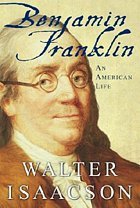
Benjamin Franklin: An American Life (Part I)


Lightening rods, libraries, fire stations, modern diplomacy, The University of Pennsylvania, the Declaration of Independence, Voltaire, and the postal service, all have Ben Franklin in common. Walter Isaacson, in his biography about Franklin does a great job of objectively and chronologically laying out Franklin's life through much research, study of letters to and from Franklin, and a bit of analysis thrown in along the way.
This 493 page hardback edition (plus another 100 pages of notes and appendices), is a very well written story of a man who intersected with so many people, activities and ideas, it seems he could have lived several lives.

Early Life

Franklin was born in 1706. He was child number seventeen and because of this could not apprentice in the family business, which was candle making. Instead, he became an apprentice to his brother in the print shop. This he began when he was only ten years old.
At age seventeen he ran away from Boston, short-changing his duties as an apprentice to his brother and went to Philadelphia. Isaacson writes that Franklin
"...had the happy talent of being at ease in almost any company, from scrappy tradesmen to wealthy merchants, scholars to rogues. His most notable trait was a personal magnetism; he attracted people who wanted to help him. Never shy, and always eager to win friends and patrons, he gregariously exploited this charm."

As Franklin arrived in Philadelphia with no money and no reputation, he journaled a manner of living that became a kind of personal credo, or at least "version one" of it. Here, at age twenty, he came up with four basic "rational" rules for how he would live his life:

  1. It is necessary for me to be extremely frugal for some time, till I have paid what I owe
  2. To endeavor to speak truth in every instance; to give nobody expectations that are not likely to be answered, but aim at sincerity in every word and action--the most amiable excellence in a rational being.
  3. To apply myself industriously to whatever business I take in hand, and not divert my mind from my business by any foolish project of suddenly growing rich; for industry and patience are the surest means of plenty
  4. I resolve to speak ill of no man whatever.
As a blossoming businessman in Philadelphia, Franklin continued to network, creating a club of tradesmen called the "Junto" where members of the middle class could assemble on a regular basis and learn from one another. They would share ideas, strike deals and build networks. Franklin used this network to his advantage over many years to follow.

Franklin, even as a teenager was forever writing "letters to the editor" or various essays about public policies, issues of the day, religious and moral issues, what have you. Having his own printing press gave him much opportunity to distribute his essays and political thoughts throughout Philadelphia and Pennsylvania through his newspaper. He would also print pamphlets that would be distributed through out the colonies. One important thing he finally received as appointment was the role of the post master. This was significant because he no longer had to pay the previous post master (also a publisher/printer) a fee to distribute his papers. As post master, Franklin began to gain control of distribution, and eventually set up post offices around the colonies. Thanks to his organization, a letter previously sent by post from New York to Philadelphia could take weeks. After Franklin organized the postal service, that time was cut to just a couple days.

One of the interesting traits of Franklin was that he was never into theoretical abstractions. He would come up with an idea and along with it a plan to implement it. His prescriptions, weather it be the Albany Plan, or ideas on how to start a fire company or build a library, always consisted of a great amount of detail regarding the internal structure and inner workings of an organization. He was a very thorough writer and thinker and almost every letter he wrote or political plan he drew up featured tedious details on exactly how a given operation, trivial or monumental, should run.

Politics

Franklin's approach to politics can be boiled down to his belief in the common man's right to assemble and elect for themselves representatives. Through out his life, until the end of the American war for Independence, Franklin's opposition were the Penn family and supporters of the appointed governors. Among the supporters for the proprietary governorships was Philadelphia's other printer, Andrew Bradford. The rivalry escalated from poking fun at eachother's printing errors to serious clashes and personal attacks over the course of a few years.

Even in the tumultuous days of the Declaration of Independence, Franklin considered himself a subject of the king and always sought a profitable way to provide electable representation of the colonies to England. Even after the Declaration of Independence was drafted and signed, Franklin still desperately sought to make the colonies an extension of the crown. Franklin believed in the ability of the people to govern themselves, but still held to a "sovereignty-of-the-state" notion that he believed could be reconciled if each served the other fairly. This of course could not be resolved politically or diplomatically and eventual war resulted.

Women

Isaacson notes that Franklin often alienated his male friends but never lost a female friend. He married Deborah Reed Rogers in 1730. Their relationship, as I'll note later was not a close friendship or romantic interest, but rather seemed to be more like a contractual obligation. She, the wife, he the husband. She work hard at home and helped with the general store in the print shop while Franklin, who loved to travel, did so frequently. While away, Franklin entrusted her with the duties on the home front, but rarely expressing a great deal of emotion regarding missing her while he was away, all while in letters, providing exact instructions regarding the finances and affairs of the home and the business.

Many of Franklin's letters reveal a quite flirtatious tone with many of the young women he met in his travels. This was the case through all his life, women of France, England, or the colonies loved him, or at least admired him, and returned the flirtatious rhetoric. Franklin, however, many times upon realizing he was approaching the moral boundaries of the relationship (especially in his letters) would suddenly feign a "but that will never happen" or a self-deprecating "Woe is me" kind of tone. As he got older, this tone would become abruptly paternal, particularly as his "intellectual" interests remained young enough to be his daughter. Franklin did genuinely enjoy the company of women, probably more than men, and found their conversations stimulating. The exceptions were Deborah, his wife, and Sally, his daughter, whom he constantly kept compartmentalized in familial roles, with more duty and obligation attached rather than love or passion of any kind.

More to follow...

Saturday, March 11, 2006

Reading Test

Tihs is wlid. Form this tmie frworad, I tihnk fturue psots sahll be pserenetd in tihs mnaenr.

Monday, February 27, 2006

Olympics

I didn't get to see too much of the Olympics this year. I enjoyed what I saw (for the most part) and watched with great interest the men's biathlon 12.5 km pursuit. What a cool concept! Cross-country ski for a couple kilometers, then with your heart pounding at 180 bpm+, shoot at five small targets. For every target you miss, you have to take a penalty lap! The lead changed quite a bit because of that!

Overall, the TV ratings for the Olympics were down this year. I was stunned to find this article in a USA Today last weekend with suggestions for how to improve the ratings. I still can't decide if it's satire or if it's honest. Here are parts of it with my comments included:

To many Americans — particularly younger people — the Olympics aren't relevant. Put simply, they aren't cool. "I hear no buzz about the Olympics any more," says Irma Zandl, a trends forecaster. "The Olympics has lost its soul."

Alright. What is THAT about? The Olympics has lost it's soul? Have the Olympics changed that much over the years? Are there not gold, silver, and bronze medals awarded for each event? What has changed here? The Olympics or the surrounding culture?

Fixing the Games' image won't be easy. Or cheap. Or without risk. But it can be done, say sports marketing gurus, image experts and event planners contacted by USA TODAY to brainstorm 10 ways to revive Olympic "cool."

Because "cool" is what it's all about.

1. Put more 'reality' in Olympic TV.

In a world of risqué reality TV shows, people crave nitty-gritty details and down-and-dirty competition.

"They should have athlete confessional rooms" where Olympians privately vent their innermost thoughts to the camera, says David Adler, founder of BiZbash Media, which produces an events trade website and magazine.

Yes, and we know from past "reality" TV programs that everything we the viewer sees is real. What is the deal? This is about the games, right? The conflict is on the ice/snow. Do we need to create artificial conflict so that somehow the athletic competition becomes more interesting, or we're somehow more attuned to the event?

Yet another way to offer more reality TV would be to reinvent the Olympic Village. With its global appeal and throngs of young, hormonally charged athletes, the Olympic Village is ripe for an uber-cool transformation — and maybe a few gimmicks.

Yes--intramural sports meets Mardi Gras. And stop using the word "Über" without the umlaut!

2. Let viewers have a say.

Viewer voting on televised competitions such as American Idol has given rise to new phenomena: official judges might get the last word, but they're no longer the only voice.

This is briliant. Allow the public to have a say in sports they can't even spell, let alone know the rules. The voting would be based on nothing more than superficial qulities of the athletes.

3. Tap more tech.

Rather than banking on the younger set watching TV, Olympic organizers need to move faster in distributing content through other media. Think more podcasting, streaming video, text messaging, even ring tones that have Olympians saying cool phrases...while this might cut prime-time viewing, he says NBC could make up lost revenue with the right fee structure. It could sell an Olympic package for "a couple hundred dollars" or sell viewing rights for individual events, sports or athletes.

You've got to be kidding. People aren't watching the Olympics now when it's brought to them for FREE, so this guy now thinks it would be a great idea to sell subscriptions just because it can appear on alternate media?

4. Spotlight big rivalries.

Any sporting event without rivalry is boring — especially the Olympic Games, says Michael Lynch, senior vice president of marketing for Olympic sponsor Visa USA.

"We could do a much better job building up the rivalries," he says.

Yeah, since the demise of the Sovient Union, the US has lost a real "bad guy" to go after. Who's left? China? Canada?

5. Decide more medals head-to-head.

Gold, silver and bronze medals in timed events could be decided by a single race pitting the three finalists with the best times, says Lynch. "The less done by the clock the better."

Wow--so now the arbiter of the highest standard is completely removed from the equasion. Can you imagine three or four people on the moguls...at the same time?

6. Offer more and hipper music, less and hipper talk

Olympic events need to move to the beat of diverse genres of current music, suggests Carol Moog, a consumer psychologist and blues harmonica player. "It should look more like a music video," she says.

For events such as snowboarding, she says, lose the TV commentary altogether in favor of a Gen Y-favored music mix.

When commentary is called for, NBC should find more young, hip voices, says Katie Paine of KDPaine & Partners, which consults on business reputations. No self-respecting teen wants someone like their father describing snowboarding, she says. "Instead of someone translating snowboard-ese into English, you need someone who actually speaks snowboard-ese."

This is a great point. As long as we're doing it to sport, let's go ahead and reduce music, language, and commentary to the lowest common denominator--so the kids can understand it.

7. Go back to the 4-year wait.

Sponsor pressure nudged organizers to reschedule the Olympic Games from every four years to separating the Winter Games and Summer Games two years apart beginning in 1994 with the Lillehammer Winter Games. "It's created Olympic fatigue," says management consultant Pam Murtaugh. "It was a pinnacle experience that has been diluted by its frequency."

Dude--whether the summer and winter games are combined or not, the wait IS STILL FOUR YEARS! So "Olympic Fatigue" would be reduced if we had both portions in the same year as opposed to one portion seperated out by two years?

8. Be less predictable.

"Unpredictability and surprises really can work to your advantage," says Don Mischer, producer of the Atlanta and Salt Lake City Olympics opening and closing ceremonies, as well as the 2006 Super Bowl half-time show. For the Atlanta Games, Mischer and a handful of people kept the last torch carrier a secret — and awed the crowd when Muhammad Ali came out.

I'm sorry--I think surprisingly few people watch the Olympics for the opening and closing ceremonies. The Olympics, after all are about the games, not the fireworks. And what's the deal with Avril Lavigne?

9. Be more extreme.

Olympic organizers could rip a page from ESPN's extremely lucrative X Games — adding a slate of grittier, heart-pumping events. For the Winter Olympics, organizers should consider adding a snowboarding competition that includes a terrain park with jumps and sliding rails, says Ron Semiao, creator of ESPN's X Games. For the Summer Olympics, he suggests adding skateboarding, bicycle motocross and motorized sports.

I can't put my finger on it, but something seems very diluted and impure about that suggestion. Maybe the motorized portion. The "snowmobiling" race? Could happen.

10. Rethink the Olympic mission.

"Is it about athletic competition at the highest level, or is it about generating revenue?" asks David Carter of Sports Business Group, a consulting firm. Like other big-time sports, the Olympics has become "addicted to the corporate dollar," he says. As a result, more critical decisions are being made by the network and sponsors, not athletes or organizers.

That this is even a question amazes me. This is continuing evidence of how big money has infiltrated all of sports--especially in the US. The ability of the team, the individual contributing unselfishly to the whole, the players/athletes team play is secondary to the money the teams make, the TV revenue generated, the big contracts the players get, etc., etc.

One more thought that may be an unfair generalization of age group who was primarily represented in the Olympics. Could it be that "the kids these days" don't have as much interest in the games because they can't relate to the hard work and dedication it took for these Olympians to achieve all that they have? Could it be that a kid's ability to do virtual snowboarding with cooler tricks that defy virtual reality leaves him uninterested in the true nature of the sport?

Could it be that a large part of overall disinterest in these games by most Americans is that we really don't know anything about the games? What are the rules? What is good form? How are they judged? How is a winner decided?

What about the time zone issue? Are we so used to seeing "instant" results, "live" as it happens that the tape delay just makes it seem less real to us?

I can't wait for the next round of Olympics.

Saturday, February 04, 2006

Various Mutterings

It's time to update the blog. Thanks for tuning in.

  • I just bought a cell phone. Actually, I bought two cell phones. We went with Sprint because my whole family is on the sprint network, as well as Eric H and David B. Janet and I will share the minutes. Happy to give you the number--just let me know that you'd like it.
  • The person the Indians will miss the most next year will not be Coco Crisp--it will be Bob Howery.
  • For the first time Wednesday morning, I had to scrape a thin layer of ice/frost off my window before leaving for the Y. By mid-day, it was in the 60s.
  • I got my NC driver's license yesterday. I decided to go in and wing the "written" test. The test was administered on a touch screen computer. There were twenty-five questions of which I had to answer 20 correctly. I JUST squeaked by. I answered twenty correctly. The things I didn't know were questions about what would happen to me if I got 7 points, what would happen if I refused a substance abuse test, etc. Next step is to help Janet pass the test then get the NC state plates. In NC, only one plate for vehicle is issued--no one has plates on the front.
  • I am currently reading a biography of Benjamin Franklin while I walk on the treadmill at the Y each day. I read about 25 minutes a day. It's going to take me a year to get through the book--unless, of course, I read it at other times!
  • I walked into the steam room at the Y for the first time Thursday. It was hot in there. Kinda hard to breathe too. I don't think I'll be spending much time in there--I like to earn my sweat the old fashioned way.
  • I don't think it's a good idea to have Steve Wozniak on This Week in Tech podcasts. He may have helped get the home computer industry going in the late 70s with Steve Jobs, but he monopolizes the podcast with uninteresting anticdotes and comments that bog it down. I think Dvorak is annoyed by him too.
  • I have a 20 Gb 3rd generation iPod that I'm using now. I like it better than the one I used before--it has a dock and it holds twice as much. I prefer the original interface, however.
  • I think I'll need to get the starter on my Mazda replaced soon. It's being temperamental.
  • I've opted for punctuation on this post, Rob.
  • I've run out of USB inputs on my G5 at work. Here are the devices that require them: iPod, Palm, MIDI interface, keyboard, external HD, and mouse (it's a long story). I had to get a USB hub from the IT guy. Some things, however only work if they're plugged directly into the computer (for some reason). The MIDI interface, I think needs to be powered directly by the computer, as well as the mouse receiver. I've finally got it figured out. I think.
  • I am also reading a great little book as a devotional that I got as a freebe at the Saddleback Worship Conference last summer. It's written by Buddy Owens and it's called The Way of the Worshiper. Starts with Romans 12: "In view of God's mercy..." I'm sure I'll comment on it further as I get into it--as well as the biography I'm working on.
  • I take an elevator to my office every day. It's on the 4th floor. Sometimes, if I really feel ambitious, I take the stairs. Never on Tuesdays or Wednesdays, however, which are the days of and after my leg day at the Y.
  • The church building requires no keys. That's kinda nice. My key chain has never been so light! Access to various floors and sections of the building is granted by a keycode that you punch into a pad by doors and in elevators and stair wells all over the building. You only have to know your one code, and with your code, the system gives you access to areas you should be able to access and blocks you out of areas you should not have access to. I mean to which you should not have access.
  • It's been a bit of a rainy day here, but the rain has stopped and it's 65 degrees out so I'm going to go for a walk while the kids are napping. It's supposed to turn cold here this week. Highs only in the upper 40s and low 50s. Some apologies to my Ohio friends.

Saturday, October 15, 2005

A Storm in Flanders

As I mentioned in my previous post, context interests me. I like to see how we arrived at where we are now, and I'm fascinated with the cyclical nature of history. Sometimes it seems like we are encountering the very worst of times, or the most interesting view on life and culture, only to find that it's just new to us-- that really, people have experienced similar things in centuries gone by, just in different, well, contexts. Sure we have technology and all these other "advances" that puts us in a unique time, but really, we're just more sophisticated (or so we think) in how we experience similar life events.

This book is about World War One. It was written by Winston Groom whom you may know better as the author of Forest Gump. Groom writes this book for Americans who know little about the first World War. As he says, most people's reference point to war (and indeed how the world has been shaped as a result for decades after) starts from World War Two.

Part of what I enjoyed about this book is how Groom gives us some pre-history. Setting the stage briefly in Europe from about the 1880's forward, and all the political, social, and economic factors that made Europe "ripe" for an eruption.

The main part of the book, however, is about the Belgian battlegrounds, commonly referred to as the "Western Front." (The name is understood from a German perspective since they were also fighting the Russians on the Eastern Front). The area of Flanders is a below sea level region that was a far less-than-ideal place for a battle ground. It rained there a lot, and the water table was so high that battles were more often than not fought in mud than on dry ground. Dogs, horses, mules and men died from being drowned in the water or stuck in the mud.

World War One represents a collision of old style war-fare and modern war fare. The use of the machine gun was new in this war. Airplanes were first used in this war; first for surveillance, then for firepower. Tanks were first used in this war, and in the end played an important role. Yet at the beginning of the war, American civil war style troop deployment and fighting was the default. This quickly changed as men were mowed down by machine guns and heavy artillery. It was in this environment that trench warfare was born.

If you have a moderate interest in history, or wonder how WW I relates to WW II, this is a great read and I highly recommend it!

Wednesday, October 12, 2005

Strength #4: Context

It shouldn't be a surprise that this post appears before I write the next post about a book I just finished. I feel like I need to explain myself.

A while ago I wrote about a test I took online related to a book I read that helps reveal a person's strengths. I listed my strengths as revealed by this test and explained a bit about the strength that appeared first, which was learner.

This other strength, as determined by this test, is context. It is defined this way:

You look back. You look back because that is where the answers lie. You look back to understand the present. From your vantage point the present is unstable, a confusing clamor of competing voices. It is only by casting your mind back to an earlier time, a time when the plans were being drawn up, that the present regains its stability. The earlier time was a simpler time. It was a time of blueprints. As you look back, you begin to see these blueprints emerge. You realize what the initial intentions were. These blueprints or intentions have since become so embellished that they are almost unrecognizable, but now this Context theme reveals them again. This understanding brings you confidence. No longer disoriented, you make better decisions because you sense the underlying structure. You become a better partner because you
understand how your colleagues came to be who they are. And counterintuitively you become wiser about the future because you saw its seeds being sown in the past. Faced with new people and new situations, it will take you a little time to orient yourself, but you must give yourself this time. You must discipline yourself to ask the questions and allow the blueprints to emerge because no matter what the situation, if you haven't seen the blueprints, you will have less confidence in your decisions.


So now that I've explained that, stay tuned for a book summary that I until now knew very little about: World War One.

Monday, October 03, 2005

Managing By Values

Thanks to Doug Clark for loaning me this book. (I guess I really oughta return it now). This book was written by Ken Blanchard and Michael O'Connor. I feel bad for O'Connor because I can never remember his name when I tell people about this book. I always end up saying something like "It's by Ken Blanchard and some other guy...poor guy!"

The book, like several other of Blanchard's book is told in a story format. He uses an interview format to help teach unfolding principals and also to set up a scenario that most people would find believable. Similar to his One Minute Manager and Who Moved My Cheese, we follow the story of a character who is frustrated by the progress his company is making and how he thinks he has little respect among his team. But after a fortuitous intersection with someone who gives a speech about the "Fortunate 500" companies, his curiosity piqued.

The book reveals some interesting insights related to organizational dynamics from a leadership/managerial standpoint (an area in which I spend very little time), and shows where a lot of companies can falter because not everyone shares an agreed upon set of values.

The bottom line is, the values become the "boss" of everyone. Every decision made can be held up against the values agreed upon by everyone in the company, and even the process for conflict resolution can be achieved through the values filter. Anyone who leads people should read this book. Especially if you are in the "higher up" portion of your company from a hierarchical standpoint. A summary of the book and the principles therein can be found in an article written by Ken Blanchard himself.

One more observation. It is so interesting to me how all these guys who study leadership and people "management" keep coming back to biblical principles. If you read John Maxwell or Jim Collins, or Ken Blanchard, they all come back to the same kinds of things over and over: esteem others as better than yourself, treat people fairly, the best leaders aren't in it for themselves, etc, etc.

Friday, September 02, 2005

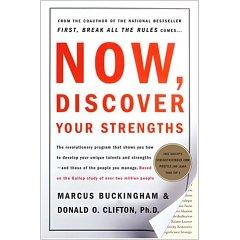
Now, Discover Your Strengths

Now, Discover Your Strengths has been a fairly significant book for me lately. Our staff at The Chapel has gone through it, but our music staff in particular has spent a good deal of time with it, using it to get to know ourselves better and thereby (hopefully) getting to know eachother better. To truely capitalize on it, your discovered strengths have to be shared with others on the team, otherwise, it will be hard to maximize your collective strengths.

The big idea of the book is that we all have been both born with strengths, and at a very young age have begun to develop them through a "forging pathways" of the brain. We "default" to these patterns. The strengths, by definition are always producing possitive results. Sometimes it's visionary, sometimes it's relational, sometimes it's steadfast beliefs. Whatever the case, we each have them. When we can combine our occupation with aspects of these strengths, we hit the "sweet spot," and things come naturally and easy to us.

Another big idea from this book is that we often spend too much time emphasizing our weaknesses. We emphasize them by trying to bring them up to the level of our strengths. This, the authors argue is a waste of our time and energy and do not serve to really energize us in whatever task we have before us. We shouldn't ignore the weaknesses, for sure, but they should not be our primary focus. For us, our endeavor should be to capitalize on what we know are our strengths.

So how do we "discover" our strengths? The authors of the book, in conjunction with Gallup surveys have interviewed over 2 million people and tabulated the data in order to see patterns emerge. With this data, you take a StrengthsFinder test and discover what yours are.
When you buy a book, on the inside flap is a code that you use at the StrengthsFinder's web site. You type in the code, take a 20-30 minute test and an instant analysis is determined to show you what your top five strengths are. My number one strength turned out to be Learner. Here's what the authors say about that characteristic:

You love to learn. The subject matter that interests you most will be determined by your other themes and experiences, but whatever the subject, you will always be drawn to the process of learning. The process, more than the content or the result, is especially exciting for you. You are energized by the steady and deliberate journey from ignorance to competence. The thrill of the first few facts, the early efforts to recite or practice what you have learned, the growing confidence of a skill mastered-this is the process that entices you. Your excitement leads you to engage in adult learning experiences-yoga or piano lessons or graduate classes. It enables you to thrive in dynamic work environments where you are asked to take on short project assignments and are expected to learn a lot about the new subject matter in a short period of time and then move on to the next one. This Learner theme does not necessarily mean that you seek to become the subject matter expert, or that you are striving for the respect that accompanies a professional or academic credential. The outcome of the learning is less significant than the "getting there."

More on my other strengths later. What's your top strength?

Brian