"William Fogarty doesn't understand the fuss. He just forgot to pay a parking ticket. When he finally realized it, the 86-year-old retiree made good and mailed in a money order, to pay a $1 ticket he got 60 years ago."
I wonder how many of my creditors will be so kind and let me wait years and years to pay back my debts...
read more | digg story

Saturday, August 12, 2006
Tuesday, July 18, 2006

Monday, July 17, 2006
Oscar Peterson
Someday I'll play like Oscar--OK, probably not. No one swings like Oscar--his rhythm sections are always so great...listen to how tight they are. For some real featured solo piano, go to about 6:00 in.


Sunday, July 16, 2006
Benjamin Franklin: An American Life (Part I)

Lightening rods, libraries, fire stations, modern diplomacy, The University of Pennsylvania, the Declaration of Independence, Voltaire, and the postal service, all have Ben Franklin in common. Walter Isaacson, in his biography about Franklin does a great job of objectively and chronologically laying out Franklin's life through much research, study of letters to and from Franklin, and a bit of analysis thrown in along the way.
This 493 page hardback edition (plus another 100 pages of notes and appendices), is a very well written story of a man who intersected with so many people, activities and ideas, it seems he could have lived several lives.
Early Life
Franklin was born in 1706. He was child number seventeen and because of this could not apprentice in the family business, which was candle making. Instead, he became an apprentice to his brother in the print shop. This he began when he was only ten years old.
At age seventeen he ran away from Boston, short-changing his duties as an apprentice to his brother and went to Philadelphia. Isaacson writes that Franklin
"...had the happy talent of being at ease in almost any company, from scrappy tradesmen to wealthy merchants, scholars to rogues. His most notable trait was a personal magnetism; he attracted people who wanted to help him. Never shy, and always eager to win friends and patrons, he gregariously exploited this charm."
As Franklin arrived in Philadelphia with no money and no reputation, he journaled a manner of living that became a kind of personal credo, or at least "version one" of it. Here, at age twenty, he came up with four basic "rational" rules for how he would live his life:
- It is necessary for me to be extremely frugal for some time, till I have paid what I owe
- To endeavor to speak truth in every instance; to give nobody expectations that are not likely to be answered, but aim at sincerity in every word and action--the most amiable excellence in a rational being.
- To apply myself industriously to whatever business I take in hand, and not divert my mind from my business by any foolish project of suddenly growing rich; for industry and patience are the surest means of plenty
- I resolve to speak ill of no man whatever.
Franklin, even as a teenager was forever writing "letters to the editor" or various essays about public policies, issues of the day, religious and moral issues, what have you. Having his own printing press gave him much opportunity to distribute his essays and political thoughts throughout Philadelphia and Pennsylvania through his newspaper. He would also print pamphlets that would be distributed through out the colonies. One important thing he finally received as appointment was the role of the post master. This was significant because he no longer had to pay the previous post master (also a publisher/printer) a fee to distribute his papers. As post master, Franklin began to gain control of distribution, and eventually set up post offices around the colonies. Thanks to his organization, a letter previously sent by post from New York to Philadelphia could take weeks. After Franklin organized the postal service, that time was cut to just a couple days.
One of the interesting traits of Franklin was that he was never into theoretical abstractions. He would come up with an idea and along with it a plan to implement it. His prescriptions, weather it be the Albany Plan, or ideas on how to start a fire company or build a library, always consisted of a great amount of detail regarding the internal structure and inner workings of an organization. He was a very thorough writer and thinker and almost every letter he wrote or political plan he drew up featured tedious details on exactly how a given operation, trivial or monumental, should run.
Politics
Franklin's approach to politics can be boiled down to his belief in the common man's right to assemble and elect for themselves representatives. Through out his life, until the end of the American war for Independence, Franklin's opposition were the Penn family and supporters of the appointed governors. Among the supporters for the proprietary governorships was Philadelphia's other printer, Andrew Bradford. The rivalry escalated from poking fun at eachother's printing errors to serious clashes and personal attacks over the course of a few years.
Even in the tumultuous days of the Declaration of Independence, Franklin considered himself a subject of the king and always sought a profitable way to provide electable representation of the colonies to England. Even after the Declaration of Independence was drafted and signed, Franklin still desperately sought to make the colonies an extension of the crown. Franklin believed in the ability of the people to govern themselves, but still held to a "sovereignty-of-the-state" notion that he believed could be reconciled if each served the other fairly. This of course could not be resolved politically or diplomatically and eventual war resulted.
Women
Isaacson notes that Franklin often alienated his male friends but never lost a female friend. He married Deborah Reed Rogers in 1730. Their relationship, as I'll note later was not a close friendship or romantic interest, but rather seemed to be more like a contractual obligation. She, the wife, he the husband. She work hard at home and helped with the general store in the print shop while Franklin, who loved to travel, did so frequently. While away, Franklin entrusted her with the duties on the home front, but rarely expressing a great deal of emotion regarding missing her while he was away, all while in letters, providing exact instructions regarding the finances and affairs of the home and the business.
Many of Franklin's letters reveal a quite flirtatious tone with many of the young women he met in his travels. This was the case through all his life, women of France, England, or the colonies loved him, or at least admired him, and returned the flirtatious rhetoric. Franklin, however, many times upon realizing he was approaching the moral boundaries of the relationship (especially in his letters) would suddenly feign a "but that will never happen" or a self-deprecating "Woe is me" kind of tone. As he got older, this tone would become abruptly paternal, particularly as his "intellectual" interests remained young enough to be his daughter. Franklin did genuinely enjoy the company of women, probably more than men, and found their conversations stimulating. The exceptions were Deborah, his wife, and Sally, his daughter, whom he constantly kept compartmentalized in familial roles, with more duty and obligation attached rather than love or passion of any kind.
More to follow...
Monday, June 26, 2006
Don't you just hate it....
Don't you just hate it when people go days and days without any blog updates? Sheesh!
We've got a lot of stuff going on right now and I have several things to post, but I'm going to wait until the dust settles and I can attempt a substantial contribution to the blogging world.
Stay tuned
We've got a lot of stuff going on right now and I have several things to post, but I'm going to wait until the dust settles and I can attempt a substantial contribution to the blogging world.
Stay tuned
Sunday, June 18, 2006
Can't get there from here
It seems a little like we've spent the last month on the road. We haven't, it just feels like it. We made a quick trip to Ohio so our kids could be a part of a wedding ceremony of a friend from our Mogadore days over Memorial Day weekend. Then, a week later, we made the long drive from Raleigh to Waterloo, Iowa.
The thing about getting to Iowa from here, unlike Ohio is that it's far from a straight shot.
It used to be that all we had to do was drive north a little bit to I-80, aka, the Ohio Turnpike and head west. After staying on I-80 for about 11 hours, one would wind up in eastern Iowa and I-380, which takes you north to Waterloo.
Our adventures from Raleigh, for any of you who may need to make the trip, went something like this:
It was interesting to ride through various topographical regions. Heading west and north from Raleigh takes you into some hills before we reach more mountainous terrain of the Appalachians (SE of this mountain range, that word is pronounced Apple-A (as it cAt) chin, NW of the range we always said Apple-ay-shun) through a few tunnels, some beautiful country side windy-road scenery, then rolling hills, still with plenty of trees through Kentucky, several river crossings, until after the Ohio River and into Indiana, things suddenly become flatter, and farmable. The further west we went, the flatter it became!
We took two days going out and the kids did really well--only one stop each day going out, and three days coming back (stopping in Indianapolis, Charleston).
Next time, I hope we can fly.
The thing about getting to Iowa from here, unlike Ohio is that it's far from a straight shot.
It used to be that all we had to do was drive north a little bit to I-80, aka, the Ohio Turnpike and head west. After staying on I-80 for about 11 hours, one would wind up in eastern Iowa and I-380, which takes you north to Waterloo.
Our adventures from Raleigh, for any of you who may need to make the trip, went something like this:
- Start at I-85. This seemed in congruous to me, because one would assume that taking I-40 would be the logical starting place, but from NW Raleigh, it makes more sense to go through the Triangle Research Park area, jump on 147, go through Durham, and end up on I-85 S, which soon takes you to
- I-40 W. Take this to Winston-Salem, then hop onto 52 W, which eventually for just about 10 miles or so becomes
- I-74, until you hit
- I-77 N. Take this out of NC, through Virginia and into West Virginia where it becomes the WV Turnpike.
- At Charleston, pick up I-64 W.
- Here is some more debate. Do you take I-64 to Lexington and then head up north to Cincinnati, or do you continue on to Louisville and go up to Indianapolis? We chose to pick up
- I-75 N to Cincinnati, where we then took I-275 around the city until we hit
- I-74. We were on this road for the longest stretch of the trip. On the way out, we drove as far as Greensburg, IN, half way between Cincinnati and Indianapolis and stayed over night. Nice little town in the middle of nowhere.
- Once you approach Indianapolis, I-74 merges with I-465 (I think) which we took going around the city and continued on through Illinois. Once in Illinois, I-74 goes from NW to a direct northerly climb at Peoria toward the Quad cities where we finally pick up I-80.
- I-80 west takes us to I-380 which takes us right to an exit to Janet's sister's place.
It was interesting to ride through various topographical regions. Heading west and north from Raleigh takes you into some hills before we reach more mountainous terrain of the Appalachians (SE of this mountain range, that word is pronounced Apple-A (as it cAt) chin, NW of the range we always said Apple-ay-shun) through a few tunnels, some beautiful country side windy-road scenery, then rolling hills, still with plenty of trees through Kentucky, several river crossings, until after the Ohio River and into Indiana, things suddenly become flatter, and farmable. The further west we went, the flatter it became!
We took two days going out and the kids did really well--only one stop each day going out, and three days coming back (stopping in Indianapolis, Charleston).
Next time, I hope we can fly.
Thursday, June 01, 2006
A little trivia
I'm almost done with my book of Benjamin Franklin. It's really a good book about an interesting man. Hopefully soon I'll get a chance to write a little post about it.
One thing I learned from it today was that there was a state that wanted to join the union under the name "Franklin." Do you know what modern day state that is? This would have been around the time of the First Continental Congress.
One thing I learned from it today was that there was a state that wanted to join the union under the name "Franklin." Do you know what modern day state that is? This would have been around the time of the First Continental Congress.
Monday, May 22, 2006
Da Vinci Hype
Gary brought it out of me. Didn't really mean to go on this little tirade, but I did. It is copied from the comment section of his blog post, which is an interesting review of the movie. Here are my comments and questions:
What do you think?
Our church, like many others, has been gearing up for the whole Da Vinci event recently. Sermons, guest lecturers, etc., have all come and warned of the herecies and inconsistencies in both the book and the movie.
I remember back when I was in college and the first Gulf War began. I was at Cedarville and there was a learned man who came to speak in one of our daily chapel services to warn us that so many things pointed to the end being near. "Jesus is coming any minute," was his big speach. He scared us all to death, in some ways, making parallels of world events to an interpretation of the last days. At this time too, there were lots of books writen about Iraq as Babylon, all sorts of articles appeared in Christian literature pointing out the parallels.
Then the year 2000. A flip of the calendar, yet somehow we, as the church, needed to be ready for disaster, because that chip with the old date sub routine written in it in the gas meter by our house was gonna explode, even though the date routine was never required of it. More hysteria, more books, more articles, get your canned foods, find shelter, be ready for anything. And a lot of it coming from and for the Christian community.
So now we have Da Vinci, and pardon my cynicism, but where was everybody when Indiana Jones raided the "Lost Ark?" "God-in-a-Box" theology with a great adventure and everything. And the "Last Crusade?" "It's time to ask yourself 'what do you believe?', Dr. Jones..." What? that the holy grail if administered correctly gives healing powers and immortality--but wait, only if you stay behind that line.
What is it that is so new that the Christian community has to study up on because of the release of this book/movie? What skewed biblical principles are being put forth that have not already assulted the Truth of God's word in other writings, books, tv shows and movies for centuries? Why now?
What person, having seen Indiana Jones is going to ask quesitons about God, and eternal life, and the holy grail? What person, after reading or watching Da Vinci is going to start an argument with a known Christian over the elements of the story and their veracity?
Why now is the Christian community suddenly implored to learn how to defend what they believe, when all along, and all around them (us) doctrines of theology and morality have been attacked for years? We are being instructed on how to debunk Da Vinci as though that is the argument to be made. As the fabled story goes (is it true?) bankers learn to identify counterfeit bills not be studying the counterfeits, but by studying the real thing.
So let's ignore the hype and be ready, Da Vinci or not, to be able to defend the reason for the hope found within us.
What do you think?
Saturday, May 13, 2006
He Restores My Soul
Part of Austin's Sunday School assignment is that he memorize several passages of scripture. One of those passages is Psalm 23. He had memorized this before, maybe two years ago, and could recite it fairly well, though it was clear that he had little understanding of it. This time, things are a little different.
Before bedtime we have a little devotional together and I've taken advantage of this time to help him not only relearn these Bible verses, but understand them as well. This time around, instead of memorizing the verses by rote, he can read the passage himself. We are going line by line through the Psalm in a somewhat condensed inductive method, exploring each phrase as he commits it to memory. We encountered the first phrase of the third verse a couple of weeks ago and I've found myself meditating on it over and over ever since.
There is a great deal of truth and insight wrapped up in this simple phrase. Here are some thoughts word by word.
He
This pronoun refers back to vs 1. It references "The LORD," Yahweh, the God of Abraham, Isaac, and Jacob, here seen as a gentle Shepherd. I was thinking about how our image of this passage is often mixed with the story Jesus told about the shepherd who went to find the one lost sheep. Knowing that one out of 100 was missing and longing for its safety, he went and searched for it until it was returned delicately to the fold. I am not a scholar enough (at all) to know if this is an unprecedented way to view Yahweh. In the Psalms we see "the LORD" as a rock, a deliverer, light, salvation, owner of the earth, etc. Only in two other Psalms is Jehovah referred to as a "Shepherd" (Ps 28 and 80). Nevertheless, the picture being painted, and the dimension being revealed of the LORD in this Psalm is of One who cares for, guides and protects those who would be led by Him.
Restores
There are a great deal of implications emanating from this single word. I think of the following, implicit in this single word: past and future; on-going; teleology; exclusivity of the Spirit; necessity of action; compliance of the recipient.
Some further expansion:
This continues to be a personal Psalm in which we realize that even though shepherds never attend just one of the sheep, this Shepherd has made himself continuously available to the individual.
The Lord is my shepherd, I shall not be in want.
He makes me lie down in green pastures,
he leads me beside quiet waters, he restores my soul.
He guides me in paths of righteousness...
Similar observations can be made throughout the remainder of the Psalm.
Soul
As mentioned earlier, this is a dimension unique to this Shepherd. Where other shepherds can only meet the needs of the physical, this Shepherd is uniquely qualified to minister directly to the spiritual needs of those He tends.
What nuggets of scripture have impacted you or ministered to you like this has to me?
Before bedtime we have a little devotional together and I've taken advantage of this time to help him not only relearn these Bible verses, but understand them as well. This time around, instead of memorizing the verses by rote, he can read the passage himself. We are going line by line through the Psalm in a somewhat condensed inductive method, exploring each phrase as he commits it to memory. We encountered the first phrase of the third verse a couple of weeks ago and I've found myself meditating on it over and over ever since.
He restores my soul.
There is a great deal of truth and insight wrapped up in this simple phrase. Here are some thoughts word by word.
He
This pronoun refers back to vs 1. It references "The LORD," Yahweh, the God of Abraham, Isaac, and Jacob, here seen as a gentle Shepherd. I was thinking about how our image of this passage is often mixed with the story Jesus told about the shepherd who went to find the one lost sheep. Knowing that one out of 100 was missing and longing for its safety, he went and searched for it until it was returned delicately to the fold. I am not a scholar enough (at all) to know if this is an unprecedented way to view Yahweh. In the Psalms we see "the LORD" as a rock, a deliverer, light, salvation, owner of the earth, etc. Only in two other Psalms is Jehovah referred to as a "Shepherd" (Ps 28 and 80). Nevertheless, the picture being painted, and the dimension being revealed of the LORD in this Psalm is of One who cares for, guides and protects those who would be led by Him.
Restores
There are a great deal of implications emanating from this single word. I think of the following, implicit in this single word: past and future; on-going; teleology; exclusivity of the Spirit; necessity of action; compliance of the recipient.
Some further expansion:
- Past and Future. The need for restoration is rooted in the past. When man sinned and each of us found ourselves with his nature, the necessity of restoration was (is) required to reestablish fellowship with the Creator. Restoration has a place of resolution seen far into the future (from the human perspective) and in fact will not be totally realized until after death
- On-going. Not a singular event. Rather, a constant, needful prodding and shaping that took place, is taking place, and will continue to take place
- Teleological. It is not an arbitrary process. There is a purpose and unique journey and role for each one being restored
- Exclusivity of the Spirit. Only God can restore. Previous verses speak of the physical needs being met. (Not being in want, green pastures, quiet waters) This restoration of the soul touches a place only the Divine can intersect. Physical contentment mentioned in surrounding verses merely masks the depth of need healed only by the Creator whose image we bear.
- Necessity of action. This process of restoration is central to fellowship with the LORD, the shepherd, and essential if we are to have hope of eternal fellowship with Him (v 5).
- Compliance of the recipient. He does not force restoration upon us, he freely gives it, but we must accept it. I have wondered if we are best made aware of our need for restoration once we settle in the green pastures and rest by the quiet waters. Perhaps here in the quiet moments can our need of restoration cut through the din of our assiduous lives.
This continues to be a personal Psalm in which we realize that even though shepherds never attend just one of the sheep, this Shepherd has made himself continuously available to the individual.
The Lord is my shepherd, I shall not be in want.
He makes me lie down in green pastures,
he leads me beside quiet waters, he restores my soul.
He guides me in paths of righteousness...
Similar observations can be made throughout the remainder of the Psalm.
Soul
As mentioned earlier, this is a dimension unique to this Shepherd. Where other shepherds can only meet the needs of the physical, this Shepherd is uniquely qualified to minister directly to the spiritual needs of those He tends.
What nuggets of scripture have impacted you or ministered to you like this has to me?
Monday, May 08, 2006
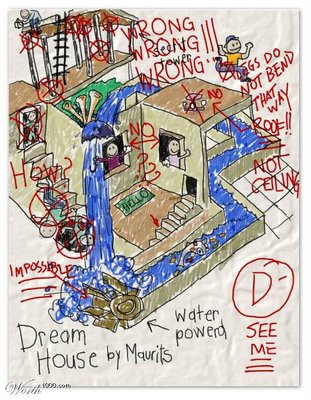
Escher Re-imagined
I'm sure you have all seen this:

This is M.C. Escher's Waterfall. For the less-informed, if you look closely at this picture, you'll see that the water flow is an impossibility, though on two-dimensional paper, it seems like it ought to work. Notice how even the supporting columns look right at the top, but not at the bottom.
Well, thanks to RocketBoom, I found this clever contest held on Worth1000.com. The rules are thus:

This is M.C. Escher's Waterfall. For the less-informed, if you look closely at this picture, you'll see that the water flow is an impossibility, though on two-dimensional paper, it seems like it ought to work. Notice how even the supporting columns look right at the top, but not at the bottom.
Well, thanks to RocketBoom, I found this clever contest held on Worth1000.com. The rules are thus:
I thought this was clever. What would a child Escher have handed in to his art teacher? And what would his teacher's responses likely be? Here's an idea:
We've all got to start somewhere, even the art masters. In this contest your task is to depict the masterpieces of the renassiance [sic] masters (or other time periods) as they were drawn when the masters were children. Do not simply edit existing masterpieces - recreate them through a child's eyes (i.e. a 3d cube would be an early MC Escher, or a paint by numbers Mondrian).
The rules of the game are thus: Show the works of the art masters (sculptures, sketches, and paintings are all fine) as though they were created by the masters when they were children (as in the themepost, "Baby Warhol" by meowza). As always, quality is a must. We will remove poor entries no matter how much we like you. You'll have 48 hours for this contest, so make your submission count.

Thursday, April 27, 2006

Tuesday, April 25, 2006
Get an Education
For any of you who wondered what it might be like to take a class at UC Berkeley, you can now do it for free. They are experimenting with putting their lectures on iTunes for free download for anyone.
I've decided to take a philosophy class called "Existentialism in Literature and Film." Here is a description of the class:
In his opening remarks, the professor admits that many students will probably not show up to class, but listen to the lecture while jogging or something. This appears to be a way to solve allowing everyone who wants to take the class to be allowed to take it without a waiting list.
Kind of interesting. This is gonna be great.
I've decided to take a philosophy class called "Existentialism in Literature and Film." Here is a description of the class:
The course will be organized around various attempts to reinterpret the Judeo/Christian God, and to determine in what sense, if at all, such a God is still a living God. We will study Dostoyevsky's and Kierkegaard's attempts to preserve a non-theological version of the God of Christianity, as well as Nietzche's attempt to save us from belief in any version of God offered by our tradition. We will view and discuss three films that deal with related issues.
In his opening remarks, the professor admits that many students will probably not show up to class, but listen to the lecture while jogging or something. This appears to be a way to solve allowing everyone who wants to take the class to be allowed to take it without a waiting list.
Kind of interesting. This is gonna be great.
Sunday, April 23, 2006
Do Not Top Off
Some time after May of 1995 my wife stopped filling the gas tank of whatever vehicle she happened to be driving. I wasn't crazy about this at first, but then it just became something that I did as a weekly routine. It gave me a chance to monitor the mileage of the vehicles--which was something I actually used to keep track of--and do little things like clean the windshield, check the fluids and all that good stuff.
I am such a creature of routine. There were a couple of things I always did (and continue to do) when putting gas in the car. First, I always wait until there is less than a quarter tank to refill it. Most people do, I think. It's just a matter of lengthening the amount of time between fill-ups. Second, I always fill the tank. I never just put five bucks in , or five gallons. I always fill it. Why? Well, I guess it's the same reason I always reset the odometer--to get an accurate assessment of my fuel consumption per mile. Even now I reset the odometer--every time--even though I never calculate the mileage. Weird.
Somewhere along the way I reasoned that I could never get a true and accurate measurement of the efficiency of the fuel I was consuming unless I knew exactly how much I was putting in. Could the automatic shut-off on the gas pumps be trusted? I didn't believe so. Especially if I went to a number of different gas stations, their mechanisms could all be very different. What if some filled me up to the top and others left a half gallon in the tank? The only way I could be sure of the most accurate measurement is if I could see exactly what was in the tank--i.e., if I could just top it off--even very slowly, I could see just where the fuel level was at the place the nozzle goes in.
Then I started noticing these little signs appearing in various places around the gas pumps. "Warning: Do Not Top Off." "Yeah, yeah, yeah," I thought, "why not? They just don't want me to spill it. I don't spill it. I'm very careful."
Finally, this week I decided to try to do a little research as to why those signs appeared at every gas station. Was it the law? Was it a suggestion? Was it personal preference?
I've since found some compelling reasons to stop topping off the tank.
It's a habit I'm going to have to learn to break, and even though I know I'm gonna feel like I'm not getting enough gas, from now on, I'm going to resist the urge to top off the tank! What do you usually do?
I am such a creature of routine. There were a couple of things I always did (and continue to do) when putting gas in the car. First, I always wait until there is less than a quarter tank to refill it. Most people do, I think. It's just a matter of lengthening the amount of time between fill-ups. Second, I always fill the tank. I never just put five bucks in , or five gallons. I always fill it. Why? Well, I guess it's the same reason I always reset the odometer--to get an accurate assessment of my fuel consumption per mile. Even now I reset the odometer--every time--even though I never calculate the mileage. Weird.
Somewhere along the way I reasoned that I could never get a true and accurate measurement of
 the efficiency of the fuel I was consuming unless I knew exactly how much I was putting in. Could the automatic shut-off on the gas pumps be trusted? I didn't believe so. Especially if I went to a number of different gas stations, their mechanisms could all be very different. What if some filled me up to the top and others left a half gallon in the tank? The only way I could be sure of the most accurate measurement is if I could see exactly what was in the tank--i.e., if I could just top it off--even very slowly, I could see just where the fuel level was at the place the nozzle goes in.
Then I started noticing these little signs appearing in various places around the gas pumps. "Warning: Do Not Top Off." "Yeah, yeah, yeah," I thought, "why not? They just don't want me to spill it. I don't spill it. I'm very careful."
Finally, this week I decided to try to do a little research as to why those signs appeared at every gas station. Was it the law? Was it a suggestion? Was it personal preference?
I've since found some compelling reasons to stop topping off the tank.
- If you over-fill your tank, the vapor recovery system, installed on most gas pump nozzles will actually suck some of the extra fuel that you just thought you used to top off your car back through the vapor line and back into the storage tank. The bad news is, of course, this fuel has been metered and you've already paid for it!
- Topping off your tank affects your car's vapor collection system which in turn will cause your car to run inefficiently.
- Spillage. This is always an issue and no matter how careful you may intend to be, you still may spill some gas outside your car. It messes up your paint and can create a potentially hazardous mess for the next customer.
- Gasoline expands after it is retrieved from the cool tank in the ground. If you fill your tank to the top, you leave no room for the gas to expand, further sabotaging your car's vapor collection system.
It's a habit I'm going to have to learn to break, and even though I know I'm gonna feel like I'm not getting enough gas, from now on, I'm going to resist the urge to top off the tank! What do you usually do?
Thursday, April 20, 2006
Sunday, April 16, 2006
Baseball is back
It's been a while since my last post (sorry) and I've noticed since I last had anything I felt was worth posting, the Major League Baseball season has started.
I was excited when I learned that the season started with the Indians at the White Sox on Sunday night, April 2nd. Excited because ESPN had requested that the game be pushed back from the original Monday afternoon start to Sunday night so that they could air a good division rivalry.
Eric, being the big fan the he is, and me, being the big fan that I am, decided we needed to ring the season in at a place where we could watch the game on a big screen. We found a Damon's and got some ribs. Dave B., Eric's brother in law, and former Ohioan joined us as did Mike P, whom we are slowly but surely converting [back] to baseball.
The game was a drag. They played three or four innings, ended up tied, CC left the game early with a strained muscle in his abdomen, then it rained (in Chicago, that is). It rained for three hours. We didn't stay for the conclusion of the game. We couldn't if we wanted to--the place closed at 10:00. In fact, I couldn't even stay awake for the conclusion of the game once it resumed.
In spite of a let down for the opening day of this season, there are a number of reasons to like baseball. Here's a list of random thoughts regarding the game and what's so great about it.
I was excited when I learned that the season started with the Indians at the White Sox on Sunday night, April 2nd. Excited because ESPN had requested that the game be pushed back from the original Monday afternoon start to Sunday night so that they could air a good division rivalry.
Eric, being the big fan the he is, and me, being the big fan that I am, decided we needed to ring the season in at a place where we could watch the game on a big screen. We found a Damon's and got some ribs. Dave B., Eric's brother in law, and former Ohioan joined us as did Mike P, whom we are slowly but surely converting [back] to baseball.
The game was a drag. They played three or four innings, ended up tied, CC left the game early with a strained muscle in his abdomen, then it rained (in Chicago, that is). It rained for three hours. We didn't stay for the conclusion of the game. We couldn't if we wanted to--the place closed at 10:00. In fact, I couldn't even stay awake for the conclusion of the game once it resumed.
In spite of a let down for the opening day of this season, there are a number of reasons to like baseball. Here's a list of random thoughts regarding the game and what's so great about it.
- 162 games plus spring training and play-offs
- You don't have to wait a week for the standings to change
- A team can overcome a multi-game losing streak and still get to the play-offs
- Minor league development
- Minor league games
- "Duct tape night"
- The "game within the game" --pitcher, batter, etc
- No cheer leaders
- Get into most MLB games for under $10. About as much as going to a movie.
- Fan participation (foul balls, bats)
- Free souvenirs
- No clock to govern the game
- Managers get tossed
- Players get tossed
- Sometimes there's even a bench-clearing fight (close to hockey, Mike and Dan)
- The defense has the ball
- Game of threes: 3 strikes/out 3 outs/half-inning, in a perfect game, each batter can face the pitcher 3 times (27 outs=9 innings)
- No "tie" column in the standings-each game played until somebody wins
- You can get a tan while watching the game
- You can eat peanuts (the perfect snack) while watching the game
- You can leave peanut shells under your seat and someone else will clean it up
- Sometimes guys collide
- Double plays
- Triple plays (I saw one once in KC)
- Hitting for the cycle
- A walk off home run
- Over 100 years of history
- You get to do corporate singing
- No replay review by the umpires
- Cool patterns in the grass.
- A closer striking out "the side" (doesn't happen for Cleveland)
- Unbelievable amount of statistics
- Inside-the-park home runs
- The many useful metaphors in life derived from baseball (step up to the plate, hit it out of the park, three strikes and you're out, etc)
- Mid-season trades
Monday, March 27, 2006
Nothing New Under the Sun
"Badly drawn, badly written...a strain on the young eyes and young nervous systems – the effect of these...nightmares is that of a violent stimulant. Their crude blacks and reds spoil a child's natural sense of color; their hypodermic injection of sex and murder make the child impatient with better, though quieter, stories. Unless we want a coming generation even more ferocious than the present one, parents and teachers throughout America must band together...”
Video games are out of control, right? The above quote was actually taken from a Chicago Daily News editorial in 1940 decrying the contemporary plight of comic books. The days of Mickey Mouse were over. On to Dick Tracey and Flash Gordon.
My recent interest in this was brought on by a series of articles, especially this one in the latest issue of Wired Magazine.
"Every generation believes that preceding generations had more moral fiber, were more devout, that young people are running amok, and that new fangled innovations are hurrying the world to ruin. The fact that every generation over the last 2400 years has believed this, that similar sentiments can be found in Pliny the Elder, Saxo Grammaticus and William Bennett, does not give us pause."
Can it get worse, or is "worse" always a constant hidden by parents and other moral authorities but always sought by the wild "punks?"
Tuesday, March 14, 2006
Delete E-mail?
I'm not sure I'm on the same page as Merlin at 43 folders. I rarely delete an e-mail. Hard drive space is inexpensive--especially when it comes to text data. Why delete? You never know when you're going to need to look something up from three, six, twelve months ago. It's easy to do a search (esp on a Mac!).
E-mail is not like snail mail with envelopes, papers, flyers, etc piling up on a desk, always demanding a sort. With e-mail, you can take care of stuff when you need to, flag it, mark as unread, forward it, etc. Why bother erasing?You lose a convenient record of what someone has sent you. What do you do?
E-mail is not like snail mail with envelopes, papers, flyers, etc piling up on a desk, always demanding a sort. With e-mail, you can take care of stuff when you need to, flag it, mark as unread, forward it, etc. Why bother erasing?You lose a convenient record of what someone has sent you. What do you do?
Saturday, March 11, 2006
Reading Test
Tihs is wlid. Form this tmie frworad, I tihnk fturue psots sahll be pserenetd in tihs mnaenr.

Saturday, March 04, 2006
Christian Doom
OK--not exactly Doom or Quake, but it's finally here! The chance for Christians to play a shoot-up game--and it's all ok to kill the enemy--if you can't convert them first. (This story has been dug).
Yes, in the ultimate extension of Christian book store "Jesus Junk," there's this from the latest issue of Newsweek:
March 6, 2006 issue - Praise the Lord and pass the ammunition: Christians are finally getting a high-caliber shoot-'em-up videogame of their own. Due out on PCs in the second half of 2006, Left Behind: Eternal Forces is the first game adapted from the blockbuster books by Tim LaHaye and Jerry Jenkins.
Let's see....what other ways can Christians still be "Christians" and still have all the fun of the rest of the world?
Yes, in the ultimate extension of Christian book store "Jesus Junk," there's this from the latest issue of Newsweek:
March 6, 2006 issue - Praise the Lord and pass the ammunition: Christians are finally getting a high-caliber shoot-'em-up videogame of their own. Due out on PCs in the second half of 2006, Left Behind: Eternal Forces is the first game adapted from the blockbuster books by Tim LaHaye and Jerry Jenkins.
Let's see....what other ways can Christians still be "Christians" and still have all the fun of the rest of the world?
Friday, March 03, 2006
Firefox Extension
For all you Firefox users out there, check out this great extension. If you're into tabbed browsing like I am, this little extension activates all the tabs like Exposé does on a mac. You can instantly see all the tabs thumbnailed. Hovering over the thumbs enlarges them, then clicking on the thumb, it activates, while the rest go away and the extension closes.
Very slick, very nicely done. Enjoy!
Oh--and it won Grand Prize from Firefox in it's category.
Very slick, very nicely done. Enjoy!
Oh--and it won Grand Prize from Firefox in it's category.
Subscribe to:
Posts (Atom)