
Thursday, December 21, 2006
Great Extension
For those of you who use Firefox, (and if you don't, WHY don't you?) there's a GREAT extension I just discovered that really enhances the tab experience. It's called Tab Mix Plus. I would disable your other tab extensions and install this one. I think it only functions in FF 2.0 or higher. Tell me what you think. I really dig it. (Digg it).


Sunday, December 17, 2006
Song in my head
Yesterday I woke up with a tune in my head. Not MY tune, some one else's tune. One of those days. I just couldn't get it out of my head no matter what. In the shower, it was there. Breakfast, the same. We went for a walk and I was grooving to it (hopefully no one knew it). I played my Christmas music station on the computer through Pandora. Once the music stopped or I walked away from the computer, it came back. I was whistling it off and on all day. I don't even really know the words.
It's not like it's a bad tune. I actually rather like it. I could have been worse. Could have been Feliz Navidad. It could have been Gilligan's Island. Thankfully it wasn't.
Does this ever happen to you?
What was my song for the day yesterday? Van Morrison's Moondance. Don't ask me why.
It's not like it's a bad tune. I actually rather like it. I could have been worse. Could have been Feliz Navidad. It could have been Gilligan's Island. Thankfully it wasn't.
Does this ever happen to you?
What was my song for the day yesterday? Van Morrison's Moondance. Don't ask me why.
Wednesday, December 13, 2006
Beauty and the Beast

We had the DVD from Blockbuster's mail service sitting by our TV for probably three weeks or so. Just never got around to watching it. Finally, I was able to convince my wife to give it a try. We put the kids to bed, popped some popcorn and put on Peter Jackson's King Kong.
I had seen this version of the movie once before. In the theater when it was released. If you have never seen PJ's version of King Kong, you should rent it. It takes a while to get moving, but we have to decide that we like Ann Darrow (Naomi Watts) and are at least suspicious of Carl Denham (Jack Black). Liking Ann was easy, and Carl was easy to like--and dislike as Jack Black did his con-artisty job of getting everyone he needed imprisoned on a ship bound for an uncharted isle. (Sounds like the makings of a bad sit-com).
PJ's version of this story is a little bit like Kong meets Jurassic Park. It's a long movie too. It took us two nights to watch the whole thing. Janet watched about two-thirds of it then decided it was time for her to go to bed.
As I watched this movie again, a thought struck me. There would never have been a story if anyone other than Ann/Naomi had been taken by the big ape. I mean, suppose the smug film director Carl/Jack was taken away by Kong. The rest of the guys from the boat would have said (in their best Seinfeld voice), "Hum, yeah, that's a shame," and probably would have booked it on out of there. But since the lovely Ann/Naomi went missing, all the guys just had to go after her. Had Jack gone missing, it would have been a much shorter story.
Let's see....which would YOU have gone after?


So here are some questions of logistics: 1) Once knocked out by a singular bottle of chloriform, how did they get Mr. Kong up onto/into the boat? 2) Are there really any more uncharted islands? 3) How did the natives come up with the technology to keep Kong out of their quaint little settlement? 4) What girl in her right mind would scale the Empire State Building? 5) Are there really that many ladders and steps to the top? 6) Could one stand at the top really? with a 25 foot monkey? 7) Come on now, can Kong really beat up three T-rex dinosaurs? 8) if you're a passer-by in Manhattan and there's a big ape on top of the ESB, and planes are firing on him to kill, would you stand down there at the foot of the building waiting for him to fall? 9) if you're Jack Driscoll/Adrien Brody, how do you feel coming in a close second to a big ape? That can't help your self-esteem.
Friday, December 01, 2006
Millions of bags of Doritos wash up on NC beach (w/pictures)
A cargo container that apparently fell from a ship washed up on the Outer Banks of North Carolina today and spilled thousands of bags of Doritos brand tortilla chips on the beach. Scavengers collected the chips, which were apparently still fresh due to their airtight packaging. I wish I was there for this.
read more | digg story
read more | digg story
Tuesday, November 28, 2006
Friday, November 10, 2006
In The Chair
More cool stuff found on YouTube. Ok, not to make this blog an aggregate reader of YouTube, but I wonder how my instrument learning days might have been different had this been available. It's worth watching the whole thing to see this technology. By the looks of it, it appears to be limited to instruments that can play only one note at a time since it seems to be designed to interpret pitch and rhythmic accuracy of a single note.
I'm fortunate to get to play with a great group of players every week, but for some folks, even experienced players, this looks like a great way to keep your ensemble chops up!
I'm fortunate to get to play with a great group of players every week, but for some folks, even experienced players, this looks like a great way to keep your ensemble chops up!
Saturday, October 14, 2006
Rueben's Tube
One of the most interesting physics experiments I've ever seen involving sound and fire. Some one needs to email him and tell him it's "Dave BRUbeck," not "Dave bruBECK!"
Good stuff! Enjoy!
Good stuff! Enjoy!
Wednesday, October 11, 2006
Pet Peeve #832
I used to think it was just Ohio drivers that did this. It's not. It's spread to North Carolina. Of course, it could have been a transplant...I don't know. But good grief, why put on your left turn signal, and the go to the RIGHT side of the lane in order to make your sweeping left turn?
We're on a two lane road with a nice shoulder. I could easily have gone around, but Nooooo. I have no choice but to hold up because for some reason to make a left, you have to go to the far right of the lane.
My approach has always been to go to the left most side of the lane, keep the wheels staight and let others get around me. Oh, and signal, of course.
We're on a two lane road with a nice shoulder. I could easily have gone around, but Nooooo. I have no choice but to hold up because for some reason to make a left, you have to go to the far right of the lane.
My approach has always been to go to the left most side of the lane, keep the wheels staight and let others get around me. Oh, and signal, of course.
Wednesday, September 27, 2006
You know you're a home owner....
....when you have to take the trash out.
....when you're concerned again about how much water you're using.
....when you make that big payment every month.
....when you begin to imagine how you might modify parts of your house's structure some day.
....when you begin to learn your neighbors' names. (apartment living is sometimes too cloistered)
.....[more from my readers?]
It's good to have a house again.
....when you're concerned again about how much water you're using.
....when you make that big payment every month.
....when you begin to imagine how you might modify parts of your house's structure some day.
....when you begin to learn your neighbors' names. (apartment living is sometimes too cloistered)
.....[more from my readers?]
It's good to have a house again.
Monday, September 18, 2006
Jesus Camp
Once while flipping around the TV channels, I stopped at the Simpson's. Pretty funny show at times because they pick on everybody, leaving no one out. (I'm not suggesting that we should all start watching the show!) On this one particular evening I watched a brief scene as Flander's kids (the token "Christian" family) told the Simpson kids that they were going to church camp "...to learn how to be more judgmental."
It made me laugh.
This ABC news report about a Jesus Camp documentary reminds me of the Simpson episode because it presents a view of Christian youth and the Christian world that is skewed by a minority but then extrapolated on the rest of Christianity as a whole. Notice how the church camp footage is interwoven throughout the piece.
It made me laugh.
This ABC news report about a Jesus Camp documentary reminds me of the Simpson episode because it presents a view of Christian youth and the Christian world that is skewed by a minority but then extrapolated on the rest of Christianity as a whole. Notice how the church camp footage is interwoven throughout the piece.
Friday, September 01, 2006
Bumper Sticker Theology
While driving home from work the other day, I found myself behind a Ford Focus with a bumper sticker on the back that looked something like this:

At first I chuckled. Then as I thought about it, I realized there was nothing here but mockery. There are so many assumptions and presuppositions written into those five words that actually communicates the opposite of any belief in Christ's return, or even Christ himself.
I remember Dr. Larson saying once that when he was a kid, growing up in evangelical fundamentalism, which yielded it's corresponding legalism, that if he was in a movie theater when Jesus returned, he wouldn't be taken with the rest of the Christians. This, of course, had nothing to do with salvation, nothing to do with eternal security and nothing to do with living in grace. These kind of Sunday school scare tactics have led to a kind of cynicism that leads to questioning the faith, the validity of salvation and even the eminence of Christ's return.
"Jesus is coming-look busy" implies that even if we believe in Christ's return, he is the mean boss pulling into the parking lot and we have to get back to work, close our solitaire (or worse), and "do Christian stuff." It makes Christ out to be a miser rather than a loving savior who freely gives.
It also implies that Jesus wouldn't know what we were doing before he returns, that he can be fooled or deceived. Underlying this thought too is the idea that "looking busy" is how we earn his approval. It's a works-based theology that takes us back to the middle ages in some ways. I picture the poor uneducated masses, muttering up some prayers paying some indulgences throwing in a little mysticism, and hoping for the best, not really sure if what they're doing will appease a distant Almighty, who hates them because of their sins.
Ultimately, the "look busy" theology identifies itself as a non-belief system. Since we don't know when Jesus is coming (after all, they've been saying that for 2000 years!), and since he evidently hasn't yet, let's go ahead and acknowledge what we're all feeling: we don't really want to look busy. It's far easier to do what we want, rather than to live for they guy who isn't here yet anyway.
As I looked up the words of the bumper sticker I came across an entire line of items with this silly little mantra emblazoned on them. If this is how you want to approach the return of Christ, you can proclaim it in any one of the following ways:
 refrigerator magnet
 a tote bag
 cooking apron,
 mouse pad,
 doggy t-shirt,
 shorts,
 a badge,
 a people t-shirt,
 a mug, and my favorite......
 a "made in the USA" thong.

At first I chuckled. Then as I thought about it, I realized there was nothing here but mockery. There are so many assumptions and presuppositions written into those five words that actually communicates the opposite of any belief in Christ's return, or even Christ himself.
I remember Dr. Larson saying once that when he was a kid, growing up in evangelical fundamentalism, which yielded it's corresponding legalism, that if he was in a movie theater when Jesus returned, he wouldn't be taken with the rest of the Christians. This, of course, had nothing to do with salvation, nothing to do with eternal security and nothing to do with living in grace. These kind of Sunday school scare tactics have led to a kind of cynicism that leads to questioning the faith, the validity of salvation and even the eminence of Christ's return.
"Jesus is coming-look busy" implies that even if we believe in Christ's return, he is the mean boss pulling into the parking lot and we have to get back to work, close our solitaire (or worse), and "do Christian stuff." It makes Christ out to be a miser rather than a loving savior who freely gives.
It also implies that Jesus wouldn't know what we were doing before he returns, that he can be fooled or deceived. Underlying this thought too is the idea that "looking busy" is how we earn his approval. It's a works-based theology that takes us back to the middle ages in some ways. I picture the poor uneducated masses, muttering up some prayers paying some indulgences throwing in a little mysticism, and hoping for the best, not really sure if what they're doing will appease a distant Almighty, who hates them because of their sins.
Ultimately, the "look busy" theology identifies itself as a non-belief system. Since we don't know when Jesus is coming (after all, they've been saying that for 2000 years!), and since he evidently hasn't yet, let's go ahead and acknowledge what we're all feeling: we don't really want to look busy. It's far easier to do what we want, rather than to live for they guy who isn't here yet anyway.
As I looked up the words of the bumper sticker I came across an entire line of items with this silly little mantra emblazoned on them. If this is how you want to approach the return of Christ, you can proclaim it in any one of the following ways:
 refrigerator magnet
  a tote bag
 cooking apron,
 mouse pad,
 doggy t-shirt,
  shorts,
 a badge,
 a people t-shirt,
 a mug, and my favorite......
 a "made in the USA" thong.
Saturday, August 12, 2006
86 Year Old Fla. Man Finally Pays $1 Parking Ticket From 1946!
"William Fogarty doesn't understand the fuss. He just forgot to pay a parking ticket. When he finally realized it, the 86-year-old retiree made good and mailed in a money order, to pay a $1 ticket he got 60 years ago."
I wonder how many of my creditors will be so kind and let me wait years and years to pay back my debts...
read more | digg story
I wonder how many of my creditors will be so kind and let me wait years and years to pay back my debts...
read more | digg story
Tuesday, July 18, 2006

Monday, July 17, 2006
Oscar Peterson
Someday I'll play like Oscar--OK, probably not. No one swings like Oscar--his rhythm sections are always so great...listen to how tight they are. For some real featured solo piano, go to about 6:00 in.
Sunday, July 16, 2006
Benjamin Franklin: An American Life (Part I)
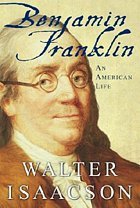
Lightening rods, libraries, fire stations, modern diplomacy, The University of Pennsylvania, the Declaration of Independence, Voltaire, and the postal service, all have Ben Franklin in common. Walter Isaacson, in his biography about Franklin does a great job of objectively and chronologically laying out Franklin's life through much research, study of letters to and from Franklin, and a bit of analysis thrown in along the way.
This 493 page hardback edition (plus another 100 pages of notes and appendices), is a very well written story of a man who intersected with so many people, activities and ideas, it seems he could have lived several lives.
Early Life
Franklin was born in 1706. He was child number seventeen and because of this could not apprentice in the family business, which was candle making. Instead, he became an apprentice to his brother in the print shop. This he began when he was only ten years old.
At age seventeen he ran away from Boston, short-changing his duties as an apprentice to his brother and went to Philadelphia. Isaacson writes that Franklin
"...had the happy talent of being at ease in almost any company, from scrappy tradesmen to wealthy merchants, scholars to rogues. His most notable trait was a personal magnetism; he attracted people who wanted to help him. Never shy, and always eager to win friends and patrons, he gregariously exploited this charm."
As Franklin arrived in Philadelphia with no money and no reputation, he journaled a manner of living that became a kind of personal credo, or at least "version one" of it. Here, at age twenty, he came up with four basic "rational" rules for how he would live his life:
- It is necessary for me to be extremely frugal for some time, till I have paid what I owe
- To endeavor to speak truth in every instance; to give nobody expectations that are not likely to be answered, but aim at sincerity in every word and action--the most amiable excellence in a rational being.
- To apply myself industriously to whatever business I take in hand, and not divert my mind from my business by any foolish project of suddenly growing rich; for industry and patience are the surest means of plenty
- I resolve to speak ill of no man whatever.
Franklin, even as a teenager was forever writing "letters to the editor" or various essays about public policies, issues of the day, religious and moral issues, what have you. Having his own printing press gave him much opportunity to distribute his essays and political thoughts throughout Philadelphia and Pennsylvania through his newspaper. He would also print pamphlets that would be distributed through out the colonies. One important thing he finally received as appointment was the role of the post master. This was significant because he no longer had to pay the previous post master (also a publisher/printer) a fee to distribute his papers. As post master, Franklin began to gain control of distribution, and eventually set up post offices around the colonies. Thanks to his organization, a letter previously sent by post from New York to Philadelphia could take weeks. After Franklin organized the postal service, that time was cut to just a couple days.
One of the interesting traits of Franklin was that he was never into theoretical abstractions. He would come up with an idea and along with it a plan to implement it. His prescriptions, weather it be the Albany Plan, or ideas on how to start a fire company or build a library, always consisted of a great amount of detail regarding the internal structure and inner workings of an organization. He was a very thorough writer and thinker and almost every letter he wrote or political plan he drew up featured tedious details on exactly how a given operation, trivial or monumental, should run.
Politics
Franklin's approach to politics can be boiled down to his belief in the common man's right to assemble and elect for themselves representatives. Through out his life, until the end of the American war for Independence, Franklin's opposition were the Penn family and supporters of the appointed governors. Among the supporters for the proprietary governorships was Philadelphia's other printer, Andrew Bradford. The rivalry escalated from poking fun at eachother's printing errors to serious clashes and personal attacks over the course of a few years.
Even in the tumultuous days of the Declaration of Independence, Franklin considered himself a subject of the king and always sought a profitable way to provide electable representation of the colonies to England. Even after the Declaration of Independence was drafted and signed, Franklin still desperately sought to make the colonies an extension of the crown. Franklin believed in the ability of the people to govern themselves, but still held to a "sovereignty-of-the-state" notion that he believed could be reconciled if each served the other fairly. This of course could not be resolved politically or diplomatically and eventual war resulted.
Women
Isaacson notes that Franklin often alienated his male friends but never lost a female friend. He married Deborah Reed Rogers in 1730. Their relationship, as I'll note later was not a close friendship or romantic interest, but rather seemed to be more like a contractual obligation. She, the wife, he the husband. She work hard at home and helped with the general store in the print shop while Franklin, who loved to travel, did so frequently. While away, Franklin entrusted her with the duties on the home front, but rarely expressing a great deal of emotion regarding missing her while he was away, all while in letters, providing exact instructions regarding the finances and affairs of the home and the business.
Many of Franklin's letters reveal a quite flirtatious tone with many of the young women he met in his travels. This was the case through all his life, women of France, England, or the colonies loved him, or at least admired him, and returned the flirtatious rhetoric. Franklin, however, many times upon realizing he was approaching the moral boundaries of the relationship (especially in his letters) would suddenly feign a "but that will never happen" or a self-deprecating "Woe is me" kind of tone. As he got older, this tone would become abruptly paternal, particularly as his "intellectual" interests remained young enough to be his daughter. Franklin did genuinely enjoy the company of women, probably more than men, and found their conversations stimulating. The exceptions were Deborah, his wife, and Sally, his daughter, whom he constantly kept compartmentalized in familial roles, with more duty and obligation attached rather than love or passion of any kind.
More to follow...
Monday, June 26, 2006
Don't you just hate it....
Don't you just hate it when people go days and days without any blog updates? Sheesh!
We've got a lot of stuff going on right now and I have several things to post, but I'm going to wait until the dust settles and I can attempt a substantial contribution to the blogging world.
Stay tuned
We've got a lot of stuff going on right now and I have several things to post, but I'm going to wait until the dust settles and I can attempt a substantial contribution to the blogging world.
Stay tuned
Sunday, June 18, 2006
Can't get there from here
It seems a little like we've spent the last month on the road. We haven't, it just feels like it. We made a quick trip to Ohio so our kids could be a part of a wedding ceremony of a friend from our Mogadore days over Memorial Day weekend. Then, a week later, we made the long drive from Raleigh to Waterloo, Iowa.
The thing about getting to Iowa from here, unlike Ohio is that it's far from a straight shot.
It used to be that all we had to do was drive north a little bit to I-80, aka, the Ohio Turnpike and head west. After staying on I-80 for about 11 hours, one would wind up in eastern Iowa and I-380, which takes you north to Waterloo.
Our adventures from Raleigh, for any of you who may need to make the trip, went something like this:
It was interesting to ride through various topographical regions. Heading west and north from Raleigh takes you into some hills before we reach more mountainous terrain of the Appalachians (SE of this mountain range, that word is pronounced Apple-A (as it cAt) chin, NW of the range we always said Apple-ay-shun) through a few tunnels, some beautiful country side windy-road scenery, then rolling hills, still with plenty of trees through Kentucky, several river crossings, until after the Ohio River and into Indiana, things suddenly become flatter, and farmable. The further west we went, the flatter it became!
We took two days going out and the kids did really well--only one stop each day going out, and three days coming back (stopping in Indianapolis, Charleston).
Next time, I hope we can fly.
The thing about getting to Iowa from here, unlike Ohio is that it's far from a straight shot.
It used to be that all we had to do was drive north a little bit to I-80, aka, the Ohio Turnpike and head west. After staying on I-80 for about 11 hours, one would wind up in eastern Iowa and I-380, which takes you north to Waterloo.
Our adventures from Raleigh, for any of you who may need to make the trip, went something like this:
- Start at I-85. This seemed in congruous to me, because one would assume that taking I-40 would be the logical starting place, but from NW Raleigh, it makes more sense to go through the Triangle Research Park area, jump on 147, go through Durham, and end up on I-85 S, which soon takes you to
- I-40 W. Take this to Winston-Salem, then hop onto 52 W, which eventually for just about 10 miles or so becomes
- I-74, until you hit
- I-77 N. Take this out of NC, through Virginia and into West Virginia where it becomes the WV Turnpike.
- At Charleston, pick up I-64 W.
- Here is some more debate. Do you take I-64 to Lexington and then head up north to Cincinnati, or do you continue on to Louisville and go up to Indianapolis? We chose to pick up
- I-75 N to Cincinnati, where we then took I-275 around the city until we hit
- I-74. We were on this road for the longest stretch of the trip. On the way out, we drove as far as Greensburg, IN, half way between Cincinnati and Indianapolis and stayed over night. Nice little town in the middle of nowhere.
- Once you approach Indianapolis, I-74 merges with I-465 (I think) which we took going around the city and continued on through Illinois. Once in Illinois, I-74 goes from NW to a direct northerly climb at Peoria toward the Quad cities where we finally pick up I-80.
- I-80 west takes us to I-380 which takes us right to an exit to Janet's sister's place.
It was interesting to ride through various topographical regions. Heading west and north from Raleigh takes you into some hills before we reach more mountainous terrain of the Appalachians (SE of this mountain range, that word is pronounced Apple-A (as it cAt) chin, NW of the range we always said Apple-ay-shun) through a few tunnels, some beautiful country side windy-road scenery, then rolling hills, still with plenty of trees through Kentucky, several river crossings, until after the Ohio River and into Indiana, things suddenly become flatter, and farmable. The further west we went, the flatter it became!
We took two days going out and the kids did really well--only one stop each day going out, and three days coming back (stopping in Indianapolis, Charleston).
Next time, I hope we can fly.
Thursday, June 01, 2006
A little trivia
I'm almost done with my book of Benjamin Franklin. It's really a good book about an interesting man. Hopefully soon I'll get a chance to write a little post about it.
One thing I learned from it today was that there was a state that wanted to join the union under the name "Franklin." Do you know what modern day state that is? This would have been around the time of the First Continental Congress.
One thing I learned from it today was that there was a state that wanted to join the union under the name "Franklin." Do you know what modern day state that is? This would have been around the time of the First Continental Congress.
Monday, May 22, 2006
Da Vinci Hype
Gary brought it out of me. Didn't really mean to go on this little tirade, but I did. It is copied from the comment section of his blog post, which is an interesting review of the movie. Here are my comments and questions:
What do you think?
Our church, like many others, has been gearing up for the whole Da Vinci event recently. Sermons, guest lecturers, etc., have all come and warned of the herecies and inconsistencies in both the book and the movie.
I remember back when I was in college and the first Gulf War began. I was at Cedarville and there was a learned man who came to speak in one of our daily chapel services to warn us that so many things pointed to the end being near. "Jesus is coming any minute," was his big speach. He scared us all to death, in some ways, making parallels of world events to an interpretation of the last days. At this time too, there were lots of books writen about Iraq as Babylon, all sorts of articles appeared in Christian literature pointing out the parallels.
Then the year 2000. A flip of the calendar, yet somehow we, as the church, needed to be ready for disaster, because that chip with the old date sub routine written in it in the gas meter by our house was gonna explode, even though the date routine was never required of it. More hysteria, more books, more articles, get your canned foods, find shelter, be ready for anything. And a lot of it coming from and for the Christian community.
So now we have Da Vinci, and pardon my cynicism, but where was everybody when Indiana Jones raided the "Lost Ark?" "God-in-a-Box" theology with a great adventure and everything. And the "Last Crusade?" "It's time to ask yourself 'what do you believe?', Dr. Jones..." What? that the holy grail if administered correctly gives healing powers and immortality--but wait, only if you stay behind that line.
What is it that is so new that the Christian community has to study up on because of the release of this book/movie? What skewed biblical principles are being put forth that have not already assulted the Truth of God's word in other writings, books, tv shows and movies for centuries? Why now?
What person, having seen Indiana Jones is going to ask quesitons about God, and eternal life, and the holy grail? What person, after reading or watching Da Vinci is going to start an argument with a known Christian over the elements of the story and their veracity?
Why now is the Christian community suddenly implored to learn how to defend what they believe, when all along, and all around them (us) doctrines of theology and morality have been attacked for years? We are being instructed on how to debunk Da Vinci as though that is the argument to be made. As the fabled story goes (is it true?) bankers learn to identify counterfeit bills not be studying the counterfeits, but by studying the real thing.
So let's ignore the hype and be ready, Da Vinci or not, to be able to defend the reason for the hope found within us.
What do you think?
Saturday, May 13, 2006
He Restores My Soul
Part of Austin's Sunday School assignment is that he memorize several passages of scripture. One of those passages is Psalm 23. He had memorized this before, maybe two years ago, and could recite it fairly well, though it was clear that he had little understanding of it. This time, things are a little different.
Before bedtime we have a little devotional together and I've taken advantage of this time to help him not only relearn these Bible verses, but understand them as well. This time around, instead of memorizing the verses by rote, he can read the passage himself. We are going line by line through the Psalm in a somewhat condensed inductive method, exploring each phrase as he commits it to memory. We encountered the first phrase of the third verse a couple of weeks ago and I've found myself meditating on it over and over ever since.
There is a great deal of truth and insight wrapped up in this simple phrase. Here are some thoughts word by word.
He
This pronoun refers back to vs 1. It references "The LORD," Yahweh, the God of Abraham, Isaac, and Jacob, here seen as a gentle Shepherd. I was thinking about how our image of this passage is often mixed with the story Jesus told about the shepherd who went to find the one lost sheep. Knowing that one out of 100 was missing and longing for its safety, he went and searched for it until it was returned delicately to the fold. I am not a scholar enough (at all) to know if this is an unprecedented way to view Yahweh. In the Psalms we see "the LORD" as a rock, a deliverer, light, salvation, owner of the earth, etc. Only in two other Psalms is Jehovah referred to as a "Shepherd" (Ps 28 and 80). Nevertheless, the picture being painted, and the dimension being revealed of the LORD in this Psalm is of One who cares for, guides and protects those who would be led by Him.
Restores
There are a great deal of implications emanating from this single word. I think of the following, implicit in this single word: past and future; on-going; teleology; exclusivity of the Spirit; necessity of action; compliance of the recipient.
Some further expansion:
This continues to be a personal Psalm in which we realize that even though shepherds never attend just one of the sheep, this Shepherd has made himself continuously available to the individual.
The Lord is my shepherd, I shall not be in want.
He makes me lie down in green pastures,
he leads me beside quiet waters, he restores my soul.
He guides me in paths of righteousness...
Similar observations can be made throughout the remainder of the Psalm.
Soul
As mentioned earlier, this is a dimension unique to this Shepherd. Where other shepherds can only meet the needs of the physical, this Shepherd is uniquely qualified to minister directly to the spiritual needs of those He tends.
What nuggets of scripture have impacted you or ministered to you like this has to me?
Before bedtime we have a little devotional together and I've taken advantage of this time to help him not only relearn these Bible verses, but understand them as well. This time around, instead of memorizing the verses by rote, he can read the passage himself. We are going line by line through the Psalm in a somewhat condensed inductive method, exploring each phrase as he commits it to memory. We encountered the first phrase of the third verse a couple of weeks ago and I've found myself meditating on it over and over ever since.
He restores my soul.
There is a great deal of truth and insight wrapped up in this simple phrase. Here are some thoughts word by word.
He
This pronoun refers back to vs 1. It references "The LORD," Yahweh, the God of Abraham, Isaac, and Jacob, here seen as a gentle Shepherd. I was thinking about how our image of this passage is often mixed with the story Jesus told about the shepherd who went to find the one lost sheep. Knowing that one out of 100 was missing and longing for its safety, he went and searched for it until it was returned delicately to the fold. I am not a scholar enough (at all) to know if this is an unprecedented way to view Yahweh. In the Psalms we see "the LORD" as a rock, a deliverer, light, salvation, owner of the earth, etc. Only in two other Psalms is Jehovah referred to as a "Shepherd" (Ps 28 and 80). Nevertheless, the picture being painted, and the dimension being revealed of the LORD in this Psalm is of One who cares for, guides and protects those who would be led by Him.
Restores
There are a great deal of implications emanating from this single word. I think of the following, implicit in this single word: past and future; on-going; teleology; exclusivity of the Spirit; necessity of action; compliance of the recipient.
Some further expansion:
- Past and Future. The need for restoration is rooted in the past. When man sinned and each of us found ourselves with his nature, the necessity of restoration was (is) required to reestablish fellowship with the Creator. Restoration has a place of resolution seen far into the future (from the human perspective) and in fact will not be totally realized until after death
- On-going. Not a singular event. Rather, a constant, needful prodding and shaping that took place, is taking place, and will continue to take place
- Teleological. It is not an arbitrary process. There is a purpose and unique journey and role for each one being restored
- Exclusivity of the Spirit. Only God can restore. Previous verses speak of the physical needs being met. (Not being in want, green pastures, quiet waters) This restoration of the soul touches a place only the Divine can intersect. Physical contentment mentioned in surrounding verses merely masks the depth of need healed only by the Creator whose image we bear.
- Necessity of action. This process of restoration is central to fellowship with the LORD, the shepherd, and essential if we are to have hope of eternal fellowship with Him (v 5).
- Compliance of the recipient. He does not force restoration upon us, he freely gives it, but we must accept it. I have wondered if we are best made aware of our need for restoration once we settle in the green pastures and rest by the quiet waters. Perhaps here in the quiet moments can our need of restoration cut through the din of our assiduous lives.
This continues to be a personal Psalm in which we realize that even though shepherds never attend just one of the sheep, this Shepherd has made himself continuously available to the individual.
The Lord is my shepherd, I shall not be in want.
He makes me lie down in green pastures,
he leads me beside quiet waters, he restores my soul.
He guides me in paths of righteousness...
Similar observations can be made throughout the remainder of the Psalm.
Soul
As mentioned earlier, this is a dimension unique to this Shepherd. Where other shepherds can only meet the needs of the physical, this Shepherd is uniquely qualified to minister directly to the spiritual needs of those He tends.
What nuggets of scripture have impacted you or ministered to you like this has to me?
Subscribe to:
Posts (Atom)