Showing posts with label learning. Show all posts

Sunday, December 07, 2008

The Five Love Languages of Children

The Five Love Languages of Children The Five Love Languages of Children by Gary Chapman


My review


rating: 4 of 5 stars
If you have children, you should read this book. The love languages apply to more than just children of course, they relate to everyone, but this book focuses on relating the love languages to children.


The authors, Gary Chapman and Ross Campbell say that by the ages of five or six you will be able to see characteristics of a dominant love language emerge in your child. The five love languages identified by the authors are 1) Quality Time, 2) Physical Touch, 3) Words of Affirmation, 4) Gifts, 5) Acts of Service.


The reason the love languages are important is because it is how you can uniquely identify with your child to help the feel loved the most. It is also a way for you to recognize when they are attempting to dispense love in their most meaningful way.


Besides simple recognition, the book spends a couple of chapters dealing with the love languages related to discipline and learning. Without a full "love tank," children will not respond well to either discipline or learning.


Again, for parents with children living at home, I would highly recommend this book.


View all my reviews.

Saturday, September 27, 2008

Blood and Thunder Review

Blood and Thunder: An Epic of the American West Blood and Thunder: An Epic of the American West by Hampton Sides


My review


rating: 5 of 5 stars
I picked this book for no reason other than I loved the last book I read by Hampton Sides. His book, Ghost Soldiers, was so well-written and thoroughly researched that he became an instant favorite of mine as an author.


This book was no different. Scholarly, but not dry; dramatic, but objectively so; focused, but set on a broad landscape of the American west, while covering a range of years from the early 19th century through just after the civil war.


"Blood and Thunder" refers to the genre of twenty-five cent pulp fiction novels which were precursors "...to the modern western, briskly paced and packed with cliffhangers and hair-raising scrapes." The subject of the Blood and Thunder stories and the central character around whom this book is based is Kit Carson.


Yet this book isn't about the exaggerated way in which these novels portrayed Carson, this book was about the "real" Kit Carson. The loyal, meek, witty, intuitive, illiterate tracker of the West.


Though Carson is the central figure in the book, the book is paradoxically not exactly about him. It is a story of Manifest Destiny, of the Navajo nation, of General Kearny, of General Carleton's vision of a Utopian Indian reservation, and even the vast terrain of the west, from the Rockies to the desserts to the canyon homes of the Indians took form as an important character in this narrative.


And the narrative, expertly woven with historical and cultural backgrounds, explanations, quotes from official documents, diaries, and letters, brings the reader along as though the account given is a novel rather than actual history.


Hampton Sides has written objectively, giving the reader a good sense of the mood of the times related to western expansion, the perspective of various Indian tribes and their histories, attitudes of Mexicans, Indians, and white Americans towards each other, and the bleak hardships of life in the West in the 19th century.


I highly recommend this book, especially if your appreciation or knowledge of this time period and geographic region is lacking. After reading it, you will have received a comprehensive picture and a narrative of this era that is balanced and far more than simply anecdotal.


View all my reviews.

Tuesday, July 01, 2008

Perpetually Surprised at Time

Janet and I began reading a A Severe Mercy a while ago. We were on a roll at first, taking turns reading it aloud before bed several nights a week. We let it slide lately, but I have been stuck on a recent passage we read and I've been turning it over in my mind a lot lately.

The story of the book is of a couple who, through a series of life-circumstances, come to find themselves at Oxford and interacting with CS Lewis. This began first by letter as Lewis recommended books for them to read, then would discuss what they read. Their exchanges deal with fundamental beliefs: likelihood of God, likelihood of redemption, and the need for salvation. The portion of the letter below is from Lewis back to them and I am intrigued by the way he frames the idea of time.

It is quite clear from what you say that you have conscious wishes on both sides. And now, another point about wishes. A wish may lead to false beliefs, granted. But what does the existence of the wish suggest? At one time I was much impressed by Arnold's line "Nor does the being hungry prove that we have bread." But surely, though it doesn't prove that one particular man will get food, it does prove that there is such a thing as food! i.e. if we were a species that didn't normally eat, weren't designed to eat, would we feel hungry? You say the materialist universe is "ugly." I wonder how you discovered that! If you are really a product of a materialistic universe, how is it you don't feel at home there? Do fish complain of the sea for being wet? Or if they did, would that fact itself not strongly suggest that they had not always been or would not always be, purely aquatic creatures? Notice how we are perpetually surprised at Time ("How time flies! Fancy John being grown--up and married! I can hardly believe it!") In heaven's name, why? Unless, indeed there is something in us which is not temporal.


I like this because I have felt it, but never articulated it. It's kind of the ontological argument for not belonging here. We don't feel time moving on as it moves on, but only when we look back and realize how much has gone by. I think most of us recognize time moving by with regret, understanding that we will never get it back. Heaven, being timeless, will redefine eternity for us. We think of eternity as never beginning and never ending, but even as we define it, we do so using terms of time. We are prone to define it as what it is not.

Saturday, June 28, 2008

Saddleback Conference, Day 4

The final day of the conference was compressed since it more or less ended mid-day with a beach gathering and bonfire at Huntington Beach later that evening. I don't know how well it was attended, and as you would expect on the last day, the attendance began to dwindle as many had to catch flights home.

Emily and I went to Alva Copeland's "Transforming Singers into Outstanding Servants." It was outstanding. Some tidbits from her talk:

  • When auditioning vocalists, the first question she asks is, "Did you come to serve?" If you came to sing, this is the wrong ministry!
  • We're looking for servants who can sing, not people who are looking to be seen.
  • Just like the disciples, sitting around looking at each other wondering "which one is the greatest?" instead striving for
  • servant leadership: group of people submitting to each other to achieve something they could not do alone
  • The platform is not for personal affirmation--the cross is for that.
  • No level of importance is attached to an assignment.
  • Nurture the "glad we can be doing something" spirit in the team. Don't ask them to make sacrifices you aren't willing to make.
  • Do not allow the pursuit of excellence to foster or fuel a performance mentality (Quest for perfection). Excellence is more about discipline and sacrifice to give something that was costly to you.
  • Set aside personal gain, abandon personal agenda.
After her session we went and got a burger at the famous "In N Out Burger" fast food chain. And yes, it was a good burger. I checked out of my hotel room and went back to campus where I explored their new "Refinery" building which is supposed to become their youth hangout facility. The building comes complete with skateboarding ramps,


a little place to buy food and chat with your friends,


an incomplete amphitheater,


a basketball court (behind the windows),


a nice view from the outside stairs going to the 2nd floor


and a game room.


From there, I wandered into the in-progress Deliriou5? concert. I wasn't too interested in hearing them, but I recorded part of their video word-feeding ideas which I thought was clever.

Finally, I met up with The Chapel gang one last time at Laguna Beach where we stood around for a while and tried to figure out where to have dinner.


They left for SNA and I hung out for a while and got some sun-setting pictures before heading off to LAX.


My flight was a 11:55pm departure to Atlanta. It was a four hour flight and I ended up in Atlanta at about 7:00am. I did not sleep well. I think I maybe got a total of two and a half hours. I was real conscientious of the guy next to me for some reason. Anyway, I slept more on the plane on the way from ATL to RDU. I don't remember the take off and when I woke up we were beginning our descent.

It was a great conference--it has been a treat to get to go there because you are surrounded by people just like you. My plea again will be for members of my staff and members of our volunteer team to be able to take it in together. There will be infinitely more musical benefit for us as a ministry and staff than yet another trip to NAB.

Thursday, June 26, 2008

Saddleback Conference, Day 3

It is very difficult to articulate the choked up feeling you get when you hear hundreds, really over a thousand voices lifting up worship with a song that is so simple, yet so well written. Such was my experience earlier today with Paul Baloche with his song "Your Name." Baloche as much as anyone seemed to understand and appreciate his audience. He led and was led by the wall of three part sound coming back at him from an enthusiastic crowd. One thing about this conference, it never lacks for worship participation nor enthusiasm. Pictures or video will never do justice, but here are some pictures of the hour we had together,


as well as the "room," completely engaged.


In a short time he encouraged worship teams, worship leaders, and spoke from the vantage point of one who knows exactly how challenging it can be to do what we do, but his words of encouragement from scripture and prayers were challenging and uplifting.

The workshop sessions today were an hour and a half each. The first one I attended was entitled "Church 2.0" which dealt with using 2.o web as an asset to not only connect our congregations and teams, but our communities and the unlimited scope of the internet gives us tools to reach the whole world. There was a lot of great content and the session was taught by Greg Atkinson, who is finishing a book of the session title.

A couple of websites of interest discussed in this session were
The next session I attended was taught mostly by Carlos Whittaker. He talked about how he used 2.0 tools to manage his team. In particular how he "cheated time" by keeping connected with people and what they're thinking through blogging and Twitter. He said he hardly ever communicates with people by email anymore. He has his team sign up for a twitter account, encourages blogging, has everyone share a del.icio.us account, share their devotional thoughts through youversion, and encourages all of them to be on Facebook so that they have a way of staying in instant and tight contact.


There was a lot of information given in these two sessions and a lot to digest, and a lot ot process practically and philosophically. It was a great day of learning for me and I'm excited to see what kinds of things I can do to implement some of these things for our team.

The evening concerts were big. Big Daddy Weave sang the first hour,

and Kirk Franklin led the second half. Everybody should experience a Franklin concert at least once. It was high-energy but well balanced. Great singers and players-the keyboard harmonies were so cool--someday I'll learn how to play like that! Best quote of the evening from KF "I didn't fly all this way just to do Stomp!"

Wednesday, June 25, 2008

Saddleback Conference, Day 2

This busy day began with a general worship session, that began with none other than Psalty. If you don't know Psalty, you probably didn't grow up in the 80's. The time ended with a group and pastor from Destiny World Church in Atlanta. They had a lot of energy. I think that is an understatement.

After our break at 10:30, we regrouped in the worship center for a worship concert with Nathan and Christy Nockels. They were great. It sounds like they have a lot going on as they are literally moving from Nashville to Atlanta this week.

The lunch break featured the usual live music around campus. First there was the Saddleback team doing some gospel tunes in a little amphitheater area, then there was the fusion jazz going on in another area. They weren't afraid to run that one loud, and Rick was prepared with ear plugs.

The rest of the afternoon were spent in workshops. The first one I attended was about improving your church's vocal team. Some of it was stuff I had heard before and things I think we practice pretty well, about being on time, being prepared as a leader to help your team be prepared, hedging and confronting pride issues, etc. The workshop ended with Tim Davis showing us how they do their vocal charts. He uses the Nashville number system. As you can see below, this system codifies parts and pitches, but does nothing for rhythms. He dictates the rhythm and then rehearses each part. The numbers represent the scale degrees. We spent some time learning this little tune.

Reasons he mentioned for using this method for their vocal teams: 1) many people can't read music, and those who can, can't read the rhythms anyway 2) he can make the chart quickly 3) he doesn't have to pound out the parts on the piano. In response to my question about transitioning people who are already used to reading notes and rhythms to this system, he responded by saying, in essence, if the team already knows how to read notes and rhythms, then don't move them, and oh, if you can find the charts with the rhythms and parts on it, then great. I think we'll be ok.

The next session I went to was a session on maximizing Ableton Live in your worship services. This was an esoteric workshop that was lightly attended, but helpful, even though it was sponsored by a vendor offering his performance tracks. The tracks they sell are actual studio tracks that are used on regular recordings (Israel, Baloche, Tomlin, etc), so you literally have the guitar, loop, pad, fxs, drum tracks, even backing vocal tracks that you can play (along with click) to fill in the spots you don't have. Pretty slick.

The last session I went to was pretty good, but it was too elementary for my experience. I am not an experienced B3 player, but I was hoping to learn more than what this class offered, which was stuff I already knew. It was nice, however, because it was set up as a lab and we all got to play along and watch what he was doing through his little camera projected on the wall.

The evening concert featured Jadon Lavik, who played and sang all of his songs with just his guitar--no band. He was excellent. Great writer and singer.

The Saddleback team presented an entire arts package, which was also excellent, centered around the American church's complacency regarding social injustices around the world, from human trafficking to AIDS in Africa. My favorite moment of the night was the Selah arrangement, which they did in the weekend services of I Bless Your Name.

After the concert, I went with my Chapel friends to the Cheesecake Factory for fun and, of course, cheescake.

Tuesday, January 29, 2008

My Nohari Window

This is the one nobody wants to do. But I'll do it. I'll be vulnerable! This is the inverse of the Johari window below. Where as the Johari window generally is kind enough to use positive characteristics to describe one's self, this one uses negative terms. Yikes!

You can be anonymous on this one as well! (And thanks to the couple of you who clicked away on my Johari window!) If you haven't done that one, please start with the my Johari window first!

Monday, January 28, 2008

My Johari Window

Thanks to Emily for discovering this. Take a second if you will, go here and click on five or six words that describe me. Don't worry you can be anonymous!

Tuesday, October 30, 2007

Prof replaces term papers with Wikipedia contributions, suffering ensues

Much attention has been given to the problem of students relying on Wikipedia as a source of information, but one professor has turned that problem on its head: instead of term papers, her students now write Wikipedia entries. [Link]

This is awesome! Yes, there are still entries in Wikipedia that need to be filled. Maybe once Wikipedia gets filled up, the prof can turn her attention toward Mahalo!

Blogged with Flock

Sunday, August 12, 2007

I am an Autodidact

I recently stumbled upon this Wikipedia entry and began to feel good about myself. What a weird thing to say. I read an entry that I think describes most of us, but I want it to describe me continually through out my life.

The entry, on Autodidacticism, describes a person who is self-educated or self-directed in learning. An autodidact, also known as an automath, is a mostly self-taught person.

Yes, I have a formal education. Yes, I is a high school and college graduit, and I even have a Master of Arts degree thrown in for good measure. But it was during that graduate time when I learned what it meant to have depth--or maybe that I learned that there is so much depth. Every discipline has it's own basic level of understanding, but one can always keep diving into levels below the "vocabulary" level where you begin to discover that there is a great deal of interconnectivity in the area you are exploring and many other disciplines.

From the article:

A person may become an autodidact at nearly any point in his or her life. While some may have been educated in a conventional manner in a particular field, they may choose to educate themselves in other, often unrelated areas.


That's me. I love exploring various interests in music, church history, American history, baseball history, baseball current, how the internet works, websites, how computers work, networking, how the mind works, social connectivity, streamlining, efficiency, lateral thinking, philosophy, art analysis, movie making, Bible study, word study, Christian apologetics, weight training, pedagogical issues in many fields. I love to dig into something but frustratingly come to a place where I don't know what to do with what I've learned. Still, the fun for me is in the learning!

Tuesday, April 17, 2007

The Dam Tour

Here are some things I didn't know about Hoover Dam:

It is 760 feet tall.


It straddles the boarder of Nevada and Arizona.


It was built during the depression.


It has smaller generators that provide the power needed to run the dam itself.

Ninety-Six people "officially" died while building the dam. Those were official government numbers of people who died on site. The distinction is important since those (in the hundreds) who died in the ambulence or at the hospital later on were not counted in the official government numbers, nor were their families awarded government compensation for their losses.


It provides electricity for parts of California, Arizona, and Nevada.


Where we were in the generator room, behind us, there was 450 feet of concrete between us and Lake Mead at a depth of 300 feet!

Here the guys are looking at some fish in the lake.

Thursday, April 12, 2007

Overheard at the Y

On Wednesdays I do a chest workout. I end by doing three sets of push ups to failure. That isn't important, but you should know this is why I overheard the following conversation. (While I was resting, and resting, and resting....)

Next to me, on a floor mat was a woman, mid-late 40's, I guess, stretching and contorting in some crazy fashion after pilates or yoga or some combination thereof. An acquaintance of hers, on the other end of the exercise mat asked her this:

"So do you miss teaching at State?"
Yoga woman: "I didn't at first but I've been missing it more and more lately."
Friend: "Are you a doctor?"
Yoga woman: "I have my Ph. D., yeah."
Friend: "What's it in?"
Yoga woman: "Thermodynamics"

So I haven't been able to get that conversation out of my mind. I wonder what it would be like to have a Ph. D. and then, for some reason, decide not to use it. It sounded like she took some time off (several years) to be with her kids while they were young.

I sometimes think about getting a Ph. D. but for me it would likely be more for the experience and growth rather than actually using it the way most people do. Both UNC and Duke offer Ph. D. degrees in musicology, but I'm scared to death of the language requirements. (German or French just to get in, plus two other languages by completion (Italian, German/French, Latin)). The actual course work would probably seem easy compared to the languages.

A Composition degree doesn't really interest me. The admission requirements are difficult, as they should be, and though I enjoy trying out an orchestration every once in a while, my passion is not composition.

The other question of earning another degree is the "what for" question. I want to learn more, and I guess if I'm going to go to the trouble I might as well earn something along the way. Oh, maybe some day.

Sunday, January 21, 2007

Readings in War

For anyone who's interested, I thought I'd share what my reading has been of late.

I recently finished a book entitled The Illusion of Victory: Americans in World War I by Thomas Fleming.

One of the crazy things about my developing interest in history is that it's really hard to know where to start. A few years ago, I was curious about how World War II started, so I did what any reasonably savvy computer user would do and checked out wikipedia and a few other Google searches. Almost every article or essay on the subject of the beginnings of World War II began with a statement something like this: "To fully understand the reasons for the start of the second World War, one must understand the reasons for the start of World War I, and the failure of the Treaty of Versailles.

Well, I knew little about World War II, I knew even less about World War I. So, I went on a little hunt, and found a great book: A Storm in Flanders. I've commented on this book before. I really found it very interesting, and as the war was, very depressing. This book focused on the Great War mostly from the European viewpoint, though the author's intent was to write it for Americans who knew little about the war.

Fleming's book, Illusion of Victory, focuses on America's involvement in the war, and primarily focuses on Woodrow Wilson's failure as president to guide the country into the war (after running for re-election with the slogan "He kept us out of war"), and his failure as diplomat as he asserted himself as an almost unwelcomed negotiator for peace on the European stage.

One of the most startling things I took from this book is how unbelievably deceptive and censoring the federal government became toward it's citizens. People live in a great deal of ignorance about the current conflict in Iraq (and I use the term "conflict" intentionally since the 2nd World War was technically the last war declared by the US). If more people had a better sense of history, (and I can say I only feel like I'm getting my bearings lately), they would be surprised at what the Wilson administration (and later the Roosevelt administration) sanctioned regarding propaganda, what we would consider political "incorrectness" today, and stubborn political unilateralism. If you weren't on board with Wilson, too bad, he was gonna do things the way he wanted them done.

As I am learning, the problem with history is that it is hard to know where to start. I have now gained a broader appreciation for the start of WW II because of understanding WW I a little better. However, there were world events that took place before WW I that influenced it! Many US military commanders of World War I got their experience from fighting in the Spanish-American War! Now who can tell me something about THAT?

More on other books I've reading to come....

Friday, November 10, 2006

In The Chair

More cool stuff found on YouTube. Ok, not to make this blog an aggregate reader of YouTube, but I wonder how my instrument learning days might have been different had this been available. It's worth watching the whole thing to see this technology. By the looks of it, it appears to be limited to instruments that can play only one note at a time since it seems to be designed to interpret pitch and rhythmic accuracy of a single note.

I'm fortunate to get to play with a great group of players every week, but for some folks, even experienced players, this looks like a great way to keep your ensemble chops up!

Saturday, October 14, 2006

Rueben's Tube

One of the most interesting physics experiments I've ever seen involving sound and fire. Some one needs to email him and tell him it's "Dave BRUbeck," not "Dave bruBECK!"
Good stuff! Enjoy!

Sunday, July 16, 2006

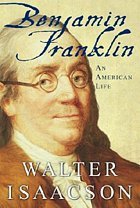
Benjamin Franklin: An American Life (Part I)


Lightening rods, libraries, fire stations, modern diplomacy, The University of Pennsylvania, the Declaration of Independence, Voltaire, and the postal service, all have Ben Franklin in common. Walter Isaacson, in his biography about Franklin does a great job of objectively and chronologically laying out Franklin's life through much research, study of letters to and from Franklin, and a bit of analysis thrown in along the way.
This 493 page hardback edition (plus another 100 pages of notes and appendices), is a very well written story of a man who intersected with so many people, activities and ideas, it seems he could have lived several lives.

Early Life

Franklin was born in 1706. He was child number seventeen and because of this could not apprentice in the family business, which was candle making. Instead, he became an apprentice to his brother in the print shop. This he began when he was only ten years old.
At age seventeen he ran away from Boston, short-changing his duties as an apprentice to his brother and went to Philadelphia. Isaacson writes that Franklin
"...had the happy talent of being at ease in almost any company, from scrappy tradesmen to wealthy merchants, scholars to rogues. His most notable trait was a personal magnetism; he attracted people who wanted to help him. Never shy, and always eager to win friends and patrons, he gregariously exploited this charm."

As Franklin arrived in Philadelphia with no money and no reputation, he journaled a manner of living that became a kind of personal credo, or at least "version one" of it. Here, at age twenty, he came up with four basic "rational" rules for how he would live his life:

  1. It is necessary for me to be extremely frugal for some time, till I have paid what I owe
  2. To endeavor to speak truth in every instance; to give nobody expectations that are not likely to be answered, but aim at sincerity in every word and action--the most amiable excellence in a rational being.
  3. To apply myself industriously to whatever business I take in hand, and not divert my mind from my business by any foolish project of suddenly growing rich; for industry and patience are the surest means of plenty
  4. I resolve to speak ill of no man whatever.
As a blossoming businessman in Philadelphia, Franklin continued to network, creating a club of tradesmen called the "Junto" where members of the middle class could assemble on a regular basis and learn from one another. They would share ideas, strike deals and build networks. Franklin used this network to his advantage over many years to follow.

Franklin, even as a teenager was forever writing "letters to the editor" or various essays about public policies, issues of the day, religious and moral issues, what have you. Having his own printing press gave him much opportunity to distribute his essays and political thoughts throughout Philadelphia and Pennsylvania through his newspaper. He would also print pamphlets that would be distributed through out the colonies. One important thing he finally received as appointment was the role of the post master. This was significant because he no longer had to pay the previous post master (also a publisher/printer) a fee to distribute his papers. As post master, Franklin began to gain control of distribution, and eventually set up post offices around the colonies. Thanks to his organization, a letter previously sent by post from New York to Philadelphia could take weeks. After Franklin organized the postal service, that time was cut to just a couple days.

One of the interesting traits of Franklin was that he was never into theoretical abstractions. He would come up with an idea and along with it a plan to implement it. His prescriptions, weather it be the Albany Plan, or ideas on how to start a fire company or build a library, always consisted of a great amount of detail regarding the internal structure and inner workings of an organization. He was a very thorough writer and thinker and almost every letter he wrote or political plan he drew up featured tedious details on exactly how a given operation, trivial or monumental, should run.

Politics

Franklin's approach to politics can be boiled down to his belief in the common man's right to assemble and elect for themselves representatives. Through out his life, until the end of the American war for Independence, Franklin's opposition were the Penn family and supporters of the appointed governors. Among the supporters for the proprietary governorships was Philadelphia's other printer, Andrew Bradford. The rivalry escalated from poking fun at eachother's printing errors to serious clashes and personal attacks over the course of a few years.

Even in the tumultuous days of the Declaration of Independence, Franklin considered himself a subject of the king and always sought a profitable way to provide electable representation of the colonies to England. Even after the Declaration of Independence was drafted and signed, Franklin still desperately sought to make the colonies an extension of the crown. Franklin believed in the ability of the people to govern themselves, but still held to a "sovereignty-of-the-state" notion that he believed could be reconciled if each served the other fairly. This of course could not be resolved politically or diplomatically and eventual war resulted.

Women

Isaacson notes that Franklin often alienated his male friends but never lost a female friend. He married Deborah Reed Rogers in 1730. Their relationship, as I'll note later was not a close friendship or romantic interest, but rather seemed to be more like a contractual obligation. She, the wife, he the husband. She work hard at home and helped with the general store in the print shop while Franklin, who loved to travel, did so frequently. While away, Franklin entrusted her with the duties on the home front, but rarely expressing a great deal of emotion regarding missing her while he was away, all while in letters, providing exact instructions regarding the finances and affairs of the home and the business.

Many of Franklin's letters reveal a quite flirtatious tone with many of the young women he met in his travels. This was the case through all his life, women of France, England, or the colonies loved him, or at least admired him, and returned the flirtatious rhetoric. Franklin, however, many times upon realizing he was approaching the moral boundaries of the relationship (especially in his letters) would suddenly feign a "but that will never happen" or a self-deprecating "Woe is me" kind of tone. As he got older, this tone would become abruptly paternal, particularly as his "intellectual" interests remained young enough to be his daughter. Franklin did genuinely enjoy the company of women, probably more than men, and found their conversations stimulating. The exceptions were Deborah, his wife, and Sally, his daughter, whom he constantly kept compartmentalized in familial roles, with more duty and obligation attached rather than love or passion of any kind.

More to follow...

Tuesday, April 25, 2006

Get an Education

For any of you who wondered what it might be like to take a class at UC Berkeley, you can now do it for free. They are experimenting with putting their lectures on iTunes for free download for anyone.

I've decided to take a philosophy class called "Existentialism in Literature and Film." Here is a description of the class:

The course will be organized around various attempts to reinterpret the Judeo/Christian God, and to determine in what sense, if at all, such a God is still a living God. We will study Dostoyevsky's and Kierkegaard's attempts to preserve a non-theological version of the God of Christianity, as well as Nietzche's attempt to save us from belief in any version of God offered by our tradition. We will view and discuss three films that deal with related issues.


In his opening remarks, the professor admits that many students will probably not show up to class, but listen to the lecture while jogging or something. This appears to be a way to solve allowing everyone who wants to take the class to be allowed to take it without a waiting list.

Kind of interesting. This is gonna be great.

Saturday, March 11, 2006

Reading Test

Tihs is wlid. Form this tmie frworad, I tihnk fturue psots sahll be pserenetd in tihs mnaenr.

Friday, February 17, 2006

My Star Trek Character

I'm not a big fan of Star Trek, but I took the test and found out who I am most like. Those of you who know me may not be surprised: (Take the test and post your result!) (and thanks to Matt Brown for the link!)

Your results:
You are Data


Data
61%
An Expendable Character (Redshirt)
60%
Jean-Luc Picard
60%
Spock
57%
Geordi LaForge
50%
Chekov
45%
Beverly Crusher
45%
James T. Kirk (Captain)
45%
Worf
40%
Will Riker
40%
Leonard McCoy (Bones)
35%
Deanna Troi
30%
Uhura
30%
Mr. Sulu
30%
Mr. Scott
25%
Even though you are a genius
you are always striving to be better.


Click here to take the "Which Star Trek character am I?" quiz...

Saturday, October 15, 2005

A Storm in Flanders

As I mentioned in my previous post, context interests me. I like to see how we arrived at where we are now, and I'm fascinated with the cyclical nature of history. Sometimes it seems like we are encountering the very worst of times, or the most interesting view on life and culture, only to find that it's just new to us-- that really, people have experienced similar things in centuries gone by, just in different, well, contexts. Sure we have technology and all these other "advances" that puts us in a unique time, but really, we're just more sophisticated (or so we think) in how we experience similar life events.

This book is about World War One. It was written by Winston Groom whom you may know better as the author of Forest Gump. Groom writes this book for Americans who know little about the first World War. As he says, most people's reference point to war (and indeed how the world has been shaped as a result for decades after) starts from World War Two.

Part of what I enjoyed about this book is how Groom gives us some pre-history. Setting the stage briefly in Europe from about the 1880's forward, and all the political, social, and economic factors that made Europe "ripe" for an eruption.

The main part of the book, however, is about the Belgian battlegrounds, commonly referred to as the "Western Front." (The name is understood from a German perspective since they were also fighting the Russians on the Eastern Front). The area of Flanders is a below sea level region that was a far less-than-ideal place for a battle ground. It rained there a lot, and the water table was so high that battles were more often than not fought in mud than on dry ground. Dogs, horses, mules and men died from being drowned in the water or stuck in the mud.

World War One represents a collision of old style war-fare and modern war fare. The use of the machine gun was new in this war. Airplanes were first used in this war; first for surveillance, then for firepower. Tanks were first used in this war, and in the end played an important role. Yet at the beginning of the war, American civil war style troop deployment and fighting was the default. This quickly changed as men were mowed down by machine guns and heavy artillery. It was in this environment that trench warfare was born.

If you have a moderate interest in history, or wonder how WW I relates to WW II, this is a great read and I highly recommend it!